
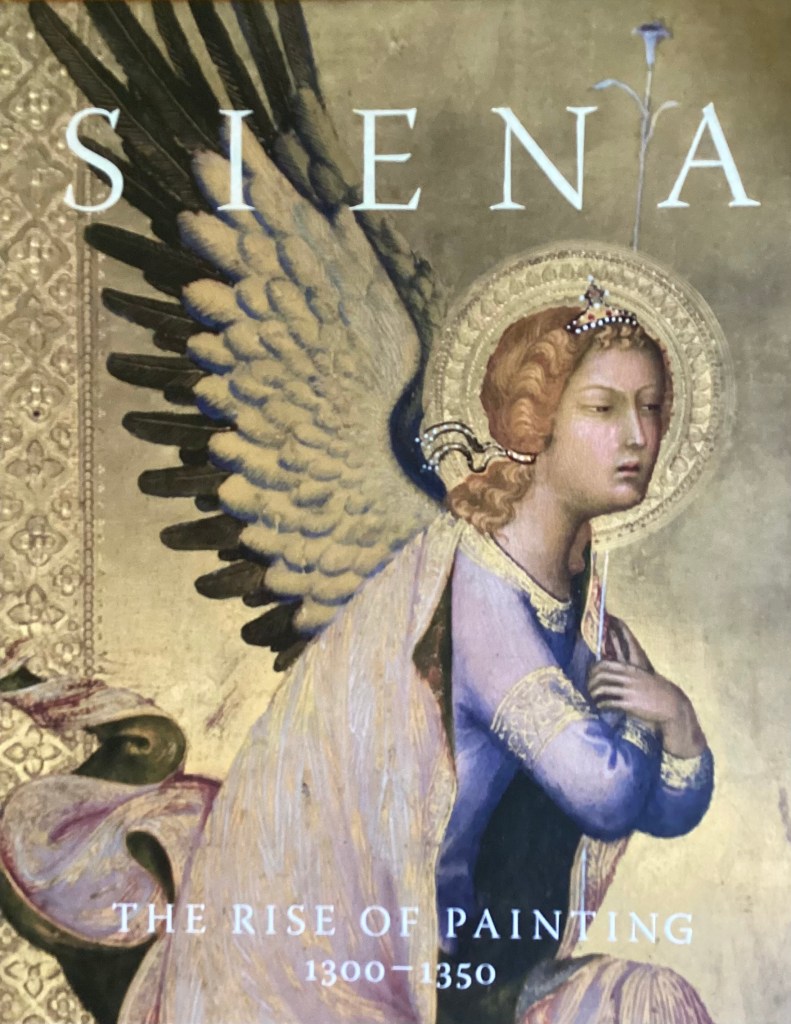
I was delighted that the National Gallery, to celebrate its 200th anniversary, was hosting an exhibition of the art of Siena 1300 – 1350; and absolutely thrilled by what I saw.
Many pieces in this exhibition were small, portable objects used as devotional aids by the many pilgrims passing through Siena as they followed the via Francigena to or from Rome. Other exhibits were much larger, and some were re-united for the first time for many centuries, having been broken up, sold, sometimes stolen, and carried off across Europe.
Duccio di Buoninsegna’s great Maestà is a case in point. Constructed in Duccio’s Sienese workshop in the teens of the 1300s, it was carried by ox cart in a great procession to the Duomo; the first double-sided altar piece in western painting: 5m square, painted and gilded on both sides. After several centuries it was removed from the Cathedral, and over time panels were dispersed or lost. Ironically, for this exhibition 33 separate pieces were brought back together from 10 collections in five different countries (and sadly several panels remain ‘lost’)
Poor reproduction showing front view and missing panels


The years between 1300 and 1350 overlap with the adult life of Dante Alighieri. He would probably have used the via Francigena to Rome in 1301 in pursuit of support from the papal state for his White Guelph ‘tribe’ in Florence, which was not forthcoming. After his banishment from Florence, Dante travelled widely in Tuscany, Liguria, the Veneto and the Marche, and may have seen some of the exhibits in their original locations, over seven hundred years ago. Astonishing.
Though the works in the exhibition concentrated on 1300 – 1350, it carried one early striking piece from c 1225 to help the visitor appreciate just how rapidly C13 artistic skills and imagination had developed.

Within 50 years, painting, sculpture and architecture were to be transformed by new technologies and materials (paints, dyes, wood, stone, marble, silk, silver and gold, not to mention spices, architecture, weaving) brought to Siena by pilgrims from all over Europe, and by oriental trade. Learn more form:
Laura Llewellyn’s presentation: https://youtu.be/DED29w92XLc?si=Wk3MCEIyGNG_fFX0
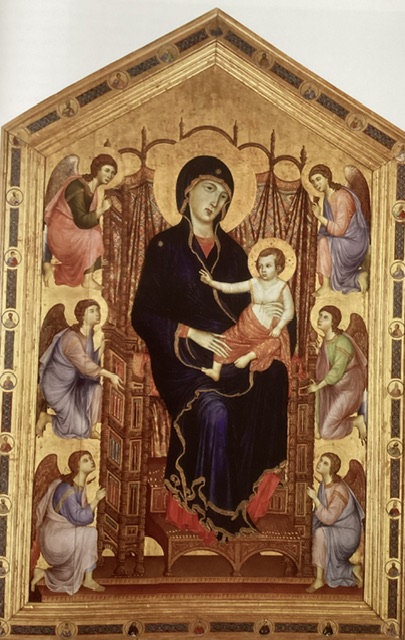
Duccio was born in Siena between the late 1255 and 1260, and died there in either 1318 or 1319. What is known about his life mainly comes from records of his debts or fines, and the locations of works attributed to him. He was of course influenced by the great Italian artists of his time – Giotto, Cimabue, but his delicacy and precision when using tempura on wood panel, and his use of gold leaf set him apart, along with his use of space, colour, human expression, and fabric. Below are five examples of his early work (the second of which, the Madonna of the Franciscans, was not in the exhibition)

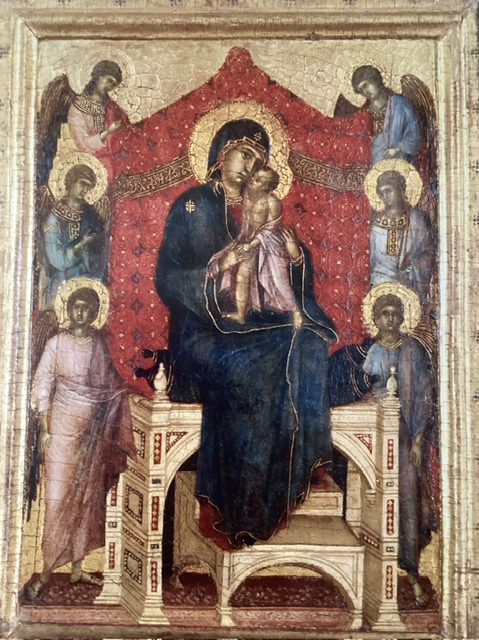

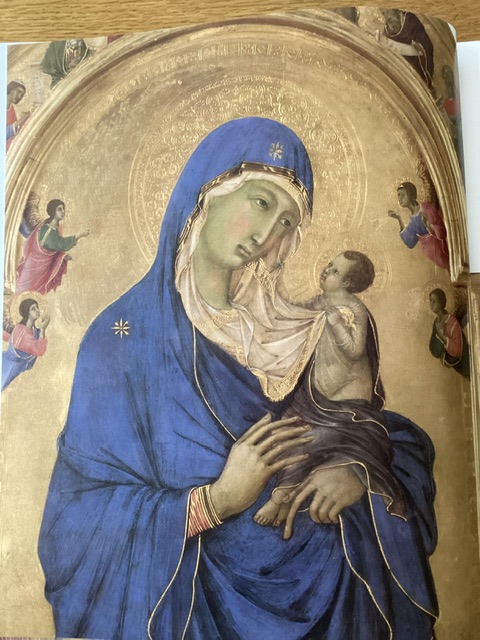
Part of the charm of the NG’s exhibition is the small scale of many of the exhibits, which invite ‘getting up close’ to see the exquisite detail and handiwork. Three triptychs by Duccio follow:
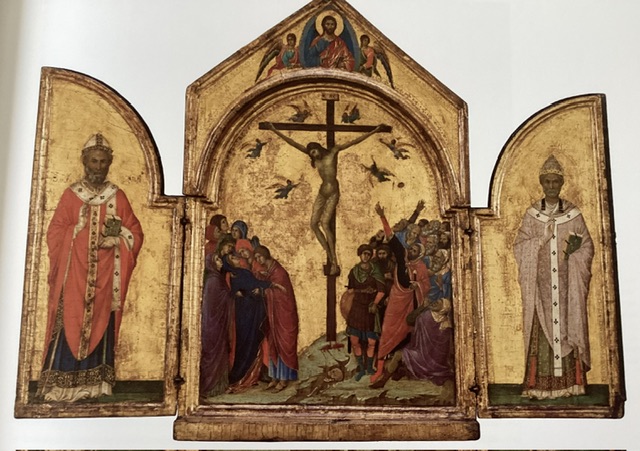
These pieces were for portable, and bought for for devotional use by wealthy pilgrims
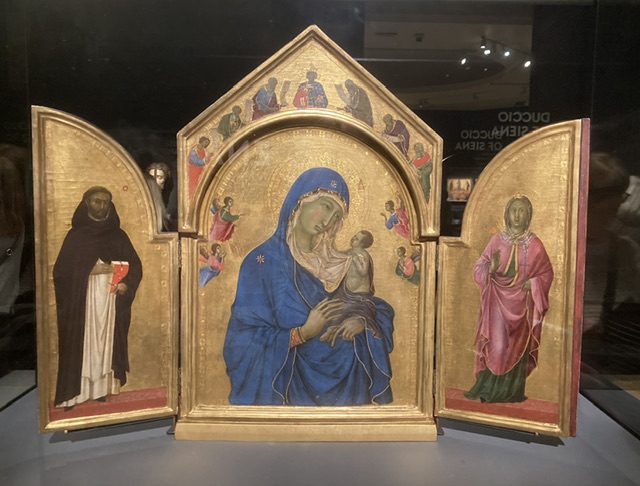
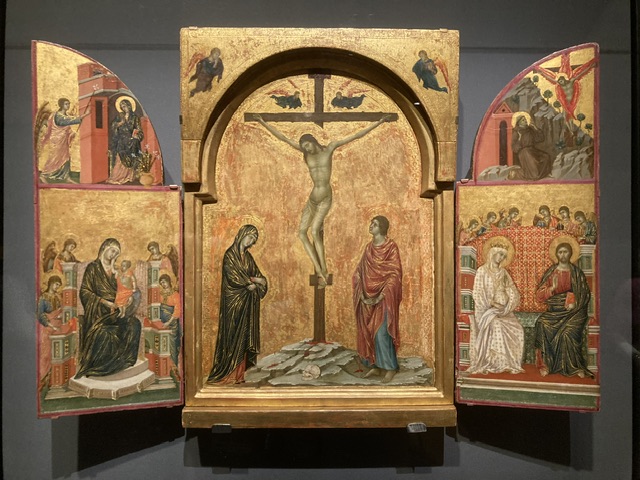

Duccio was not alone in producing this amazing art. The pieces which follow are the work of notable (if younger) contemporaries, Pietro Lorenzetti, and Simone Martini, who were undoubtedly influenced by Duccio, and some of whose works were also part of the Siena exhibition. (Note: it included the work of Ambrogio Lorenzetti, Pietro’s younger brother; he enjoys a special mention at the close of this piece!)
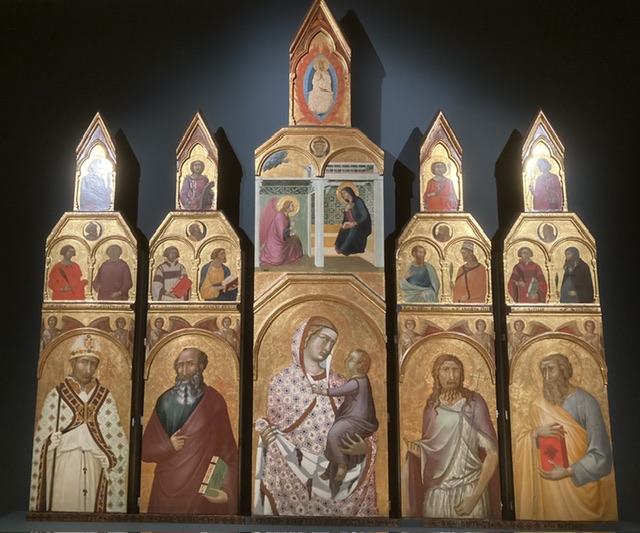
C 1320 : Pietro Lorenzetti’s massive Pieve altar piece

On 17 April 1320, Pietro Lorenzetti signed a contract to paint a monumental multi-panelled altarpiece for the church of Santa Maria della Pieve at Arezzo.
Exceptionally, the painter signed the altarpiece twice, most prominently beneath the Virgin:
‘Pietro Lorenzetti of Siena made this [work] with his right hand’. It is Pietro’s earliest documented work. Nonetheless, it already demonstrates his extraordinary artistic skill and the desirability of his paintings outside Siena. Below are two more examples from the exhibition of of his later work

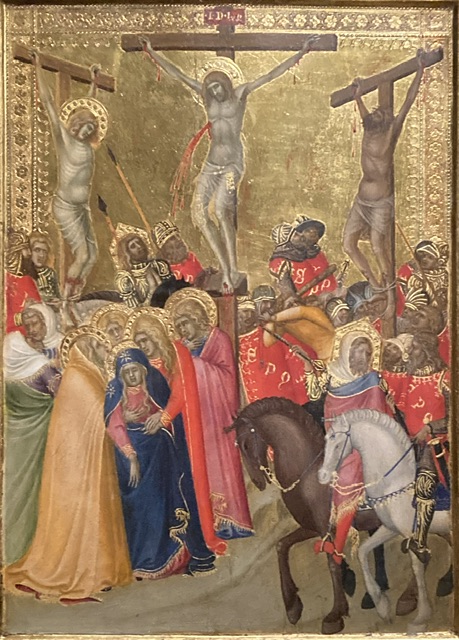
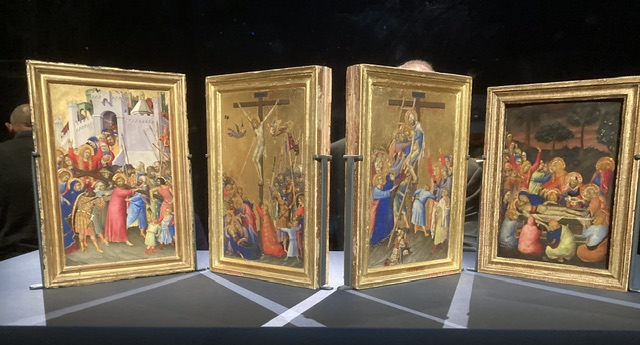

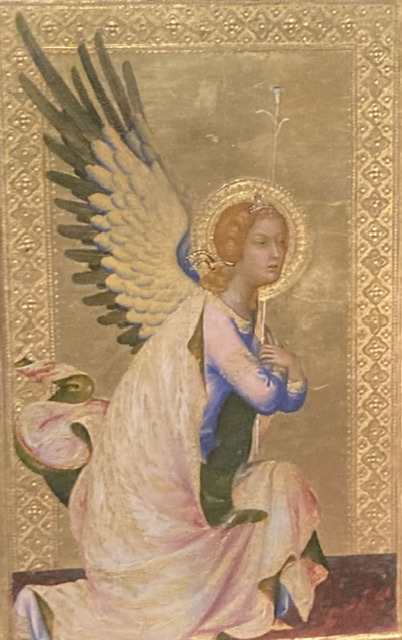
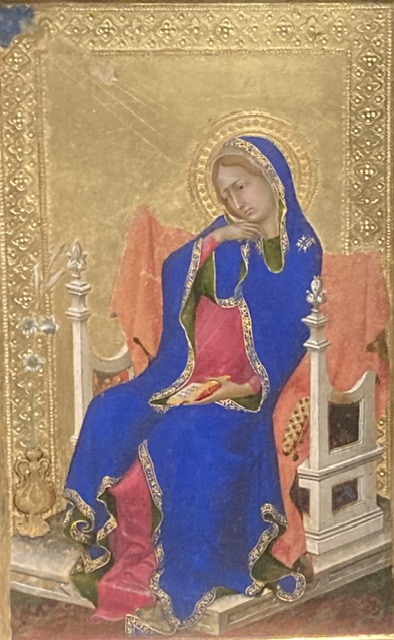
Simone Marinti painted this work while he was still in Síena. He probably made it for Cardinal Napoleone Orsini, who had moved to Avignon around 1310, perhaps receiving the painting there. Simone depicts him at the foot of the cross in the Deposition.
Its two sides carry very different themes: the Annunciation and a Passion cycle. It is perhaps a free-standing, miniature, double-sided altarpiece, a distant echo of Duccio’s Maestà.
Simone Martini also gave us this very recognisable scene of the missing Jesus, having been tracked down to the Temple, being confronted by his worried and perhaps cross parents.
We’ve all been there!


The Maestà of Duccio di Buoninsegna, 1317, and bearing the inscription on Mary’s footstool:
“Holy Mother of God, be thou the cause of peace for Siena and of life for Duccio because he painted thee thus”
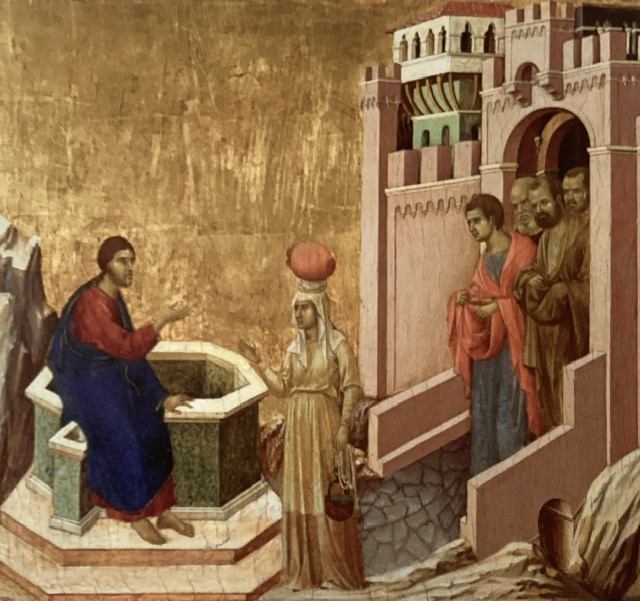
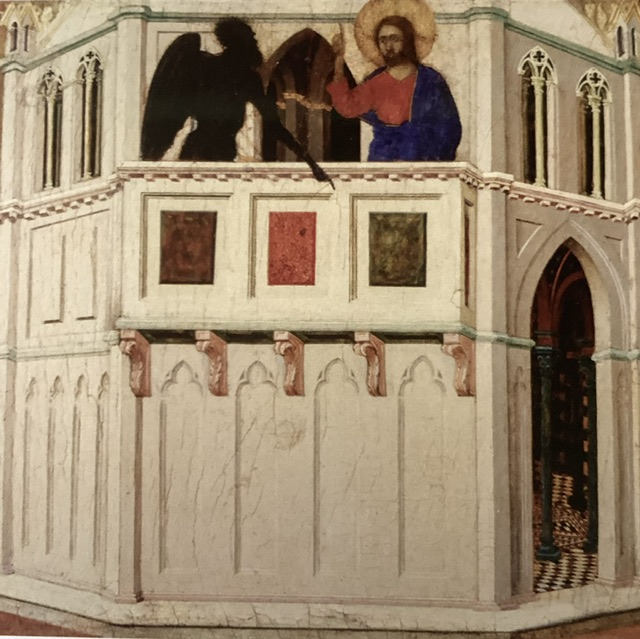
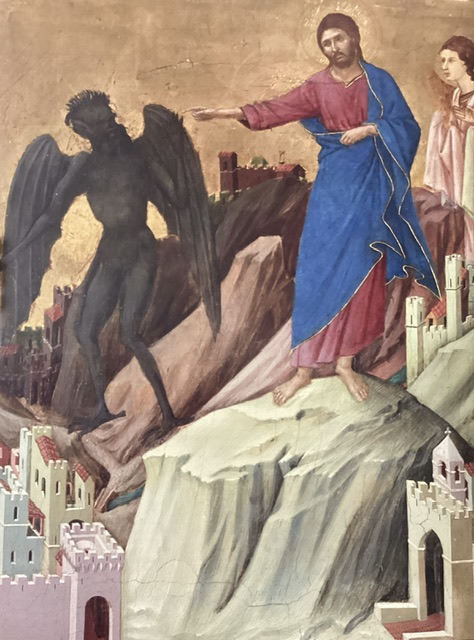
What follows are some examples of the panels which appear on both sides of the Maestà. It was a privilege to be able to see close up these beautiful pieces brought together from around the world. It was an extraordinarily moving exhibition.



Postscript:
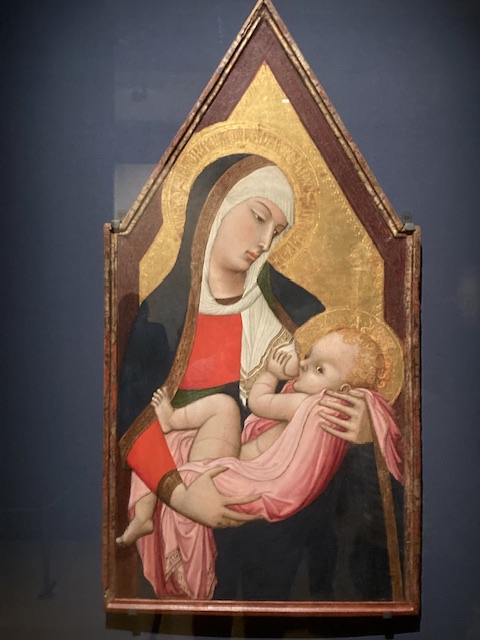
The exhibition contained many other pieces to illustrate the wealth of artistic expression to be found in Siena at this time; too many to celebrate here. But some mention should be made of the work of Ambrogio Lorenzetti, a younger brother of Pietro, who produced extraordinary work, some of it for secular authorities as well as religious patrons. Above is his Madonna del Latte painted c 1325.
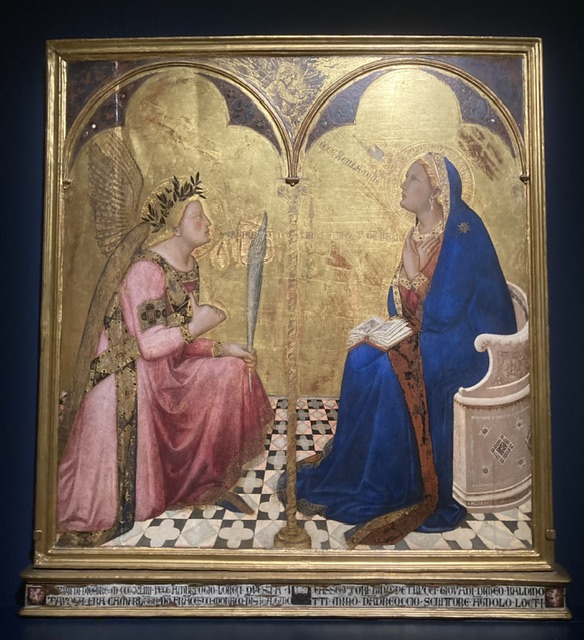
Siena claimed Mary, mother of God, as its champion in heaven and on earth, attributing their unlikely success in 1260 at the famous battle of Montaperti against a much stronger Florentine army to her intercessions.) Ambrogio’s painting The Annunciation (1344) above was a civic commission by the tax office!
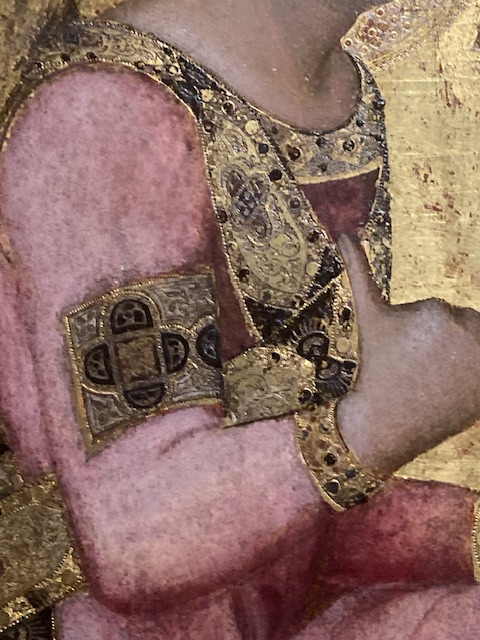
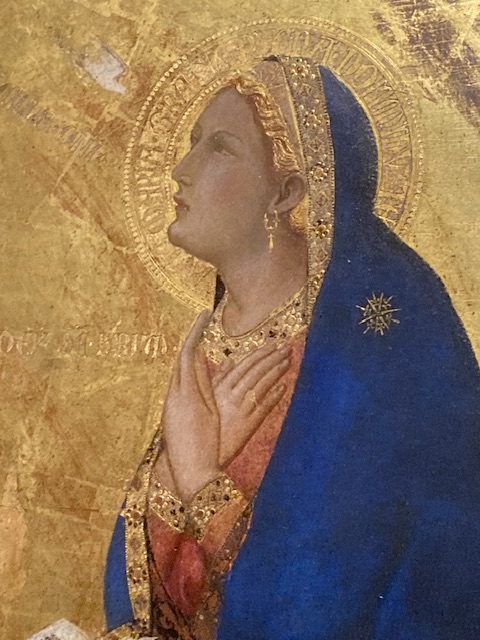
Perhaps Ambrogio’s most famous work is in Siena’s Palazzo Pubblico; frescoes representing The Allegory of Good – and Bad – Government, which were not part of this exhibition.
Nor was his Maestà, which we have seen in the Gallery in Massa Marittima. What follows are photos taken at its exhibition of Ambrogio’s work executed in the Maremma area, 50 km to the south of Siena. It is remarkable that there are so many astonishing pieces still to be found in the places for which they were painted, more than seven hundred years ago.
It is shocking to learn that this extraordinary explosion of talent and creativity emanating from Siena in the 1300s came to a sudden, tragic end in 1348 when the Black Death Plague killed 1 in 3 of the inhabitants of Siena, including both the Lorenzetti brothers, and Simone Martini.
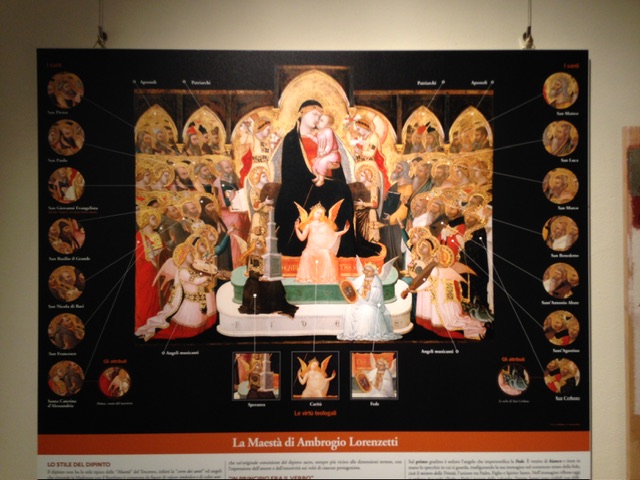
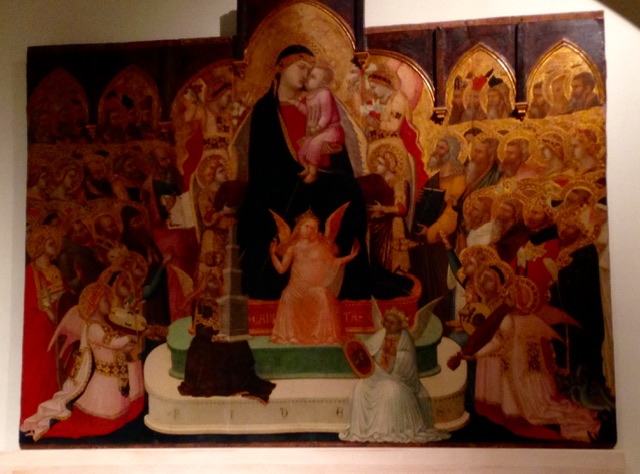
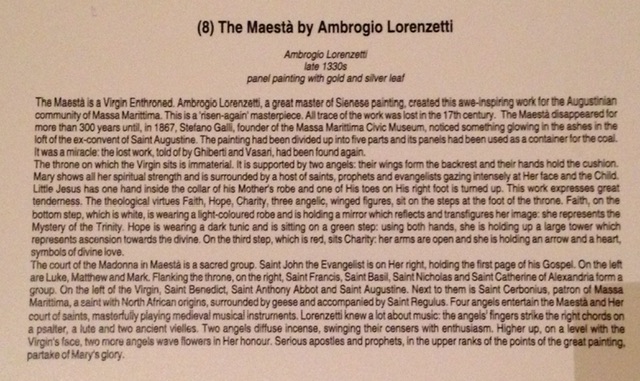
In addition, there are pieces of Ambrogio’s work from other parts of Tuscany eg RHS below

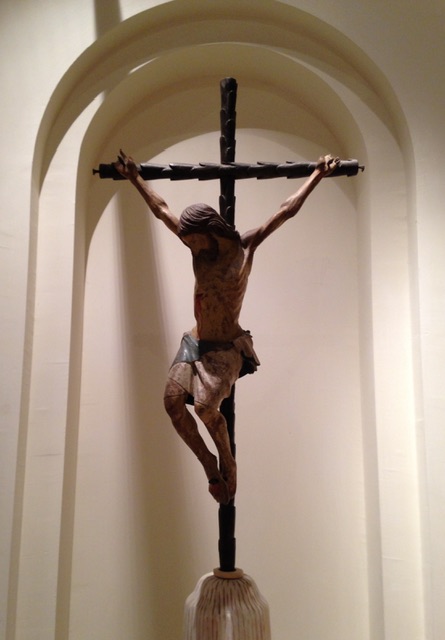
And above an exquisite wooden crucifix carved by Giovanni Pisano c 1310 on the RHS
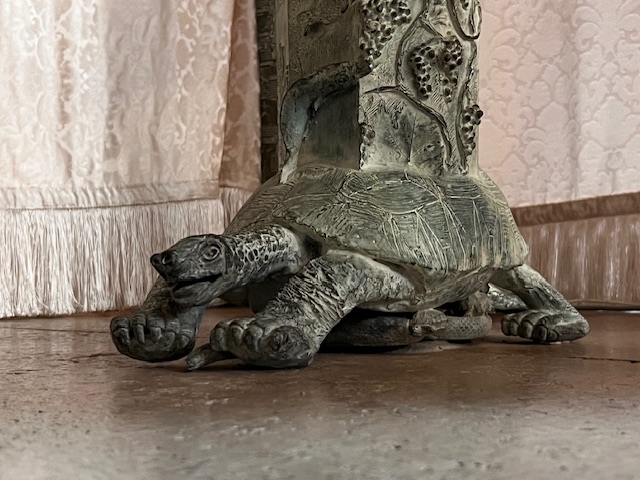
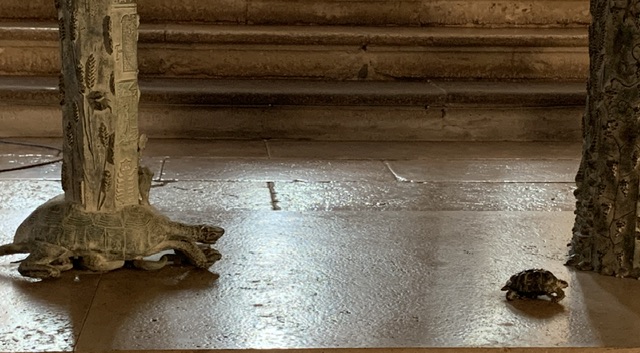
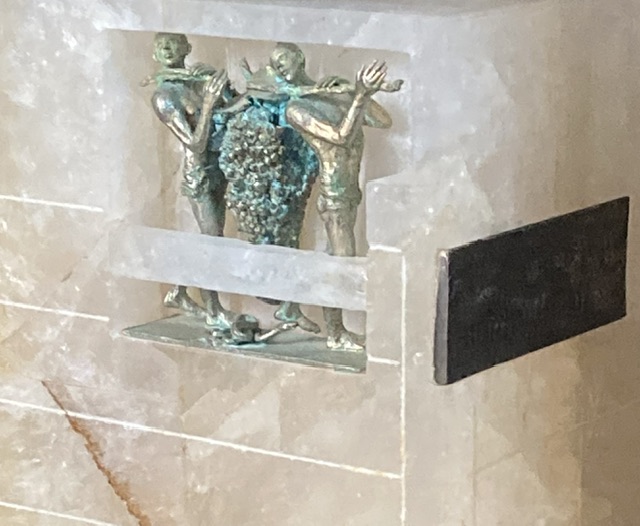
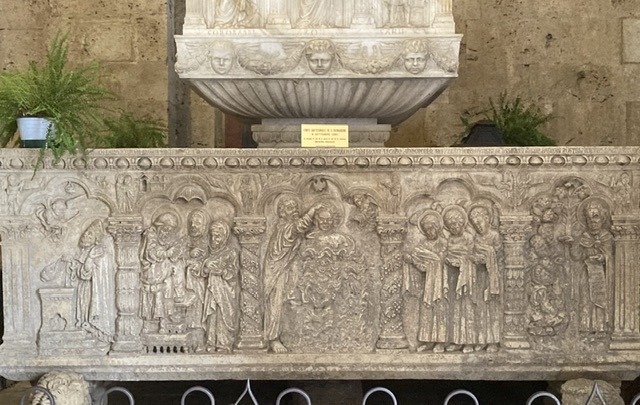
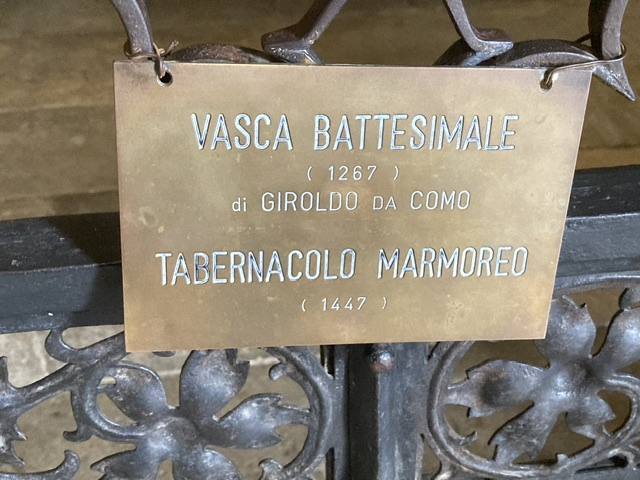
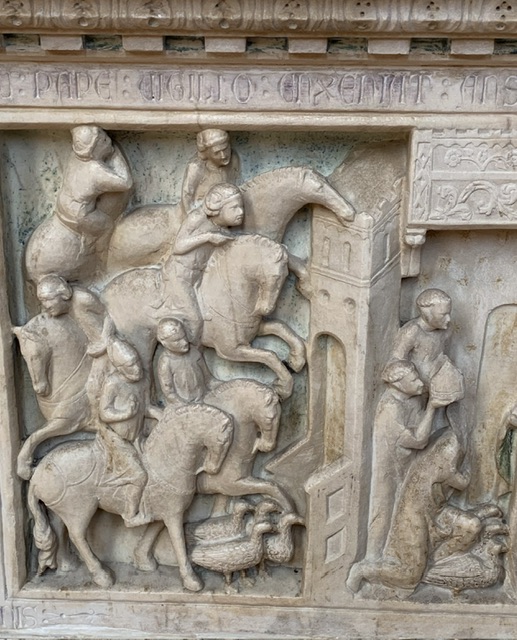
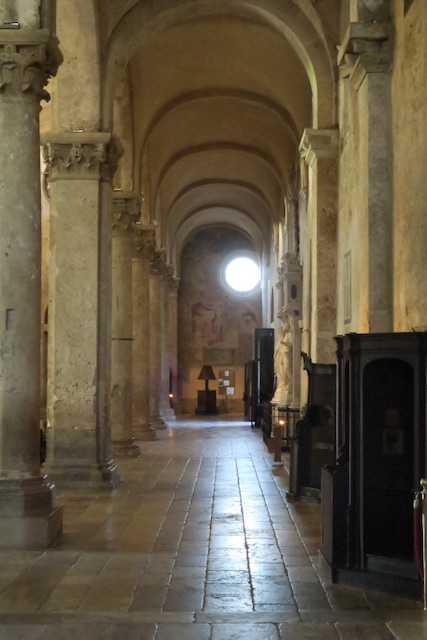
Massa Marittima’s fine Art Gallery has a wealth of material from which we can deduce how widespread the impact and influence of the Sienese art of the fourteenth century was throughout Tuscany. And the Cathedral of San Cerbone still contains today a number of outstanding pieces: the baptismal font in which San Bernardino was himself baptised; and behind the High Altar, the tomb carved in the twelfth century to house the remains of San Cerbone, with its carvings of the miraculous, and some glorious contemporary touches – its marble ‘cathedra’ or bishop’s seat, and supporting its altar, some very life like tortoises…




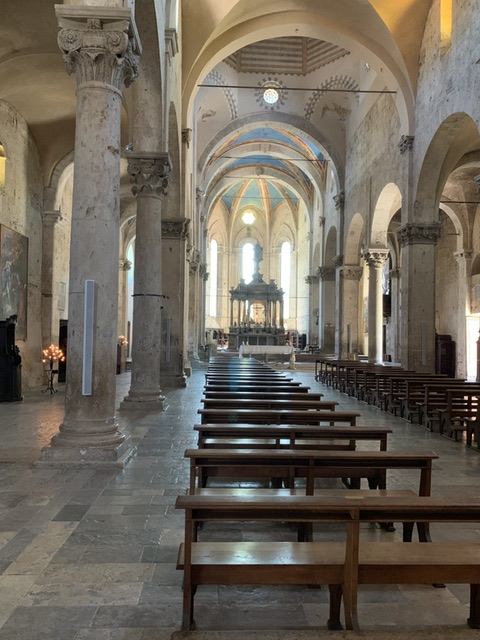
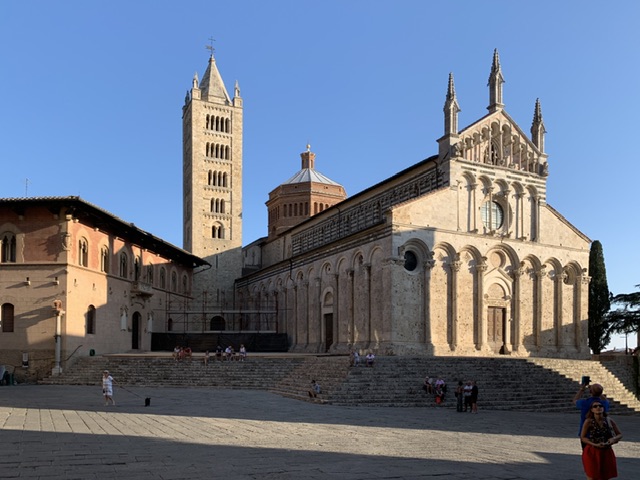
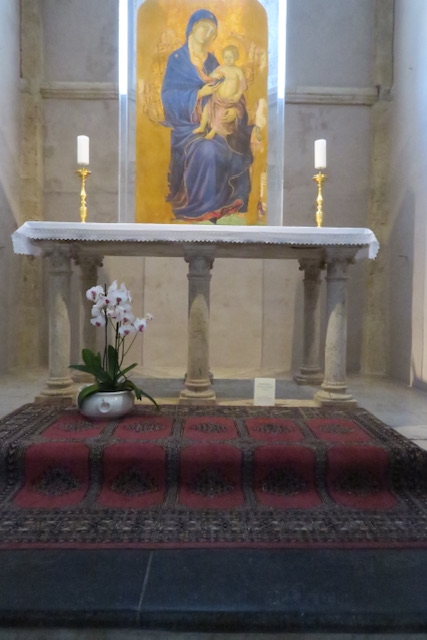
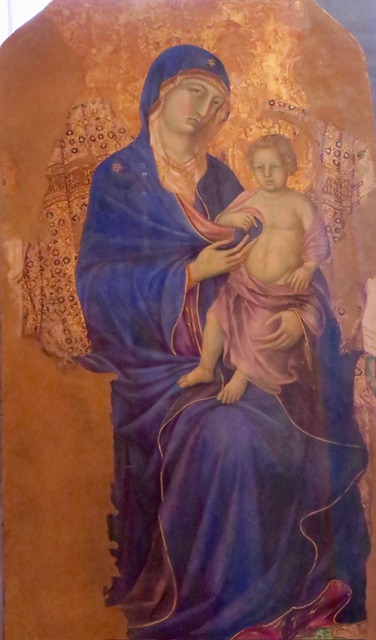
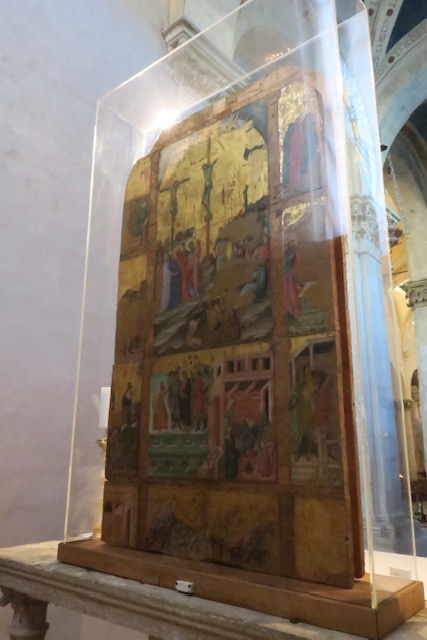
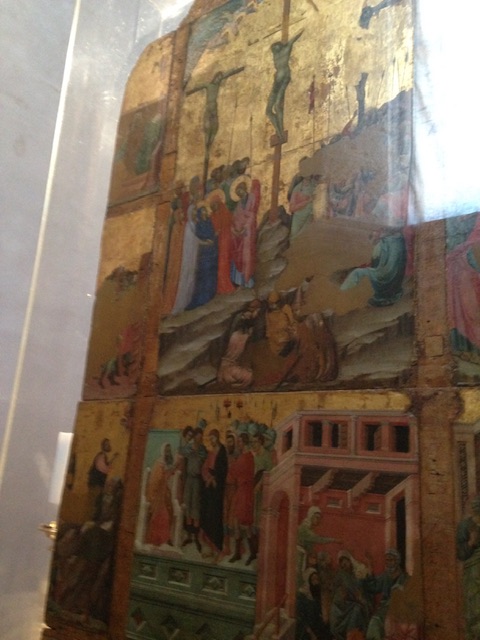
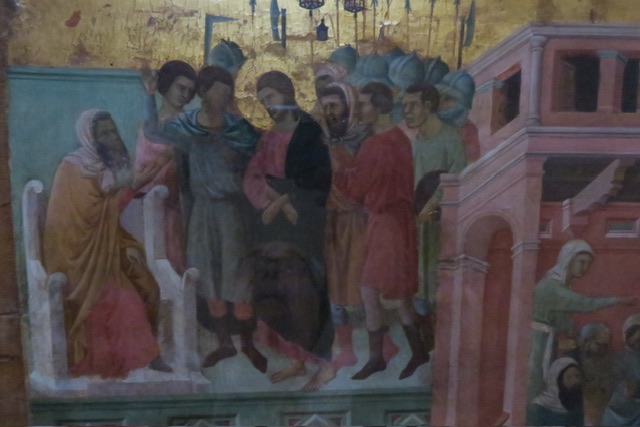
Last, but not least, is a fourteenth century painting : the Madonna delle Grazie of 1317 ascribed to Duccio himself, with panels on its rear side reminiscent of the great Maestà in Siena. It stands as a reredos for the North Aisle altar, a focus of devotion still, and decorated with flowers. Extraordinary!


 countrymouse