
While David served as the wine expert on the Wine Scholar Guild’s tasting tour of Piemonte, Hugh and I embarked on Naturetrek ‘s Summer on Shetland: Seabirds and Cetaceans. We had a fabulous time.
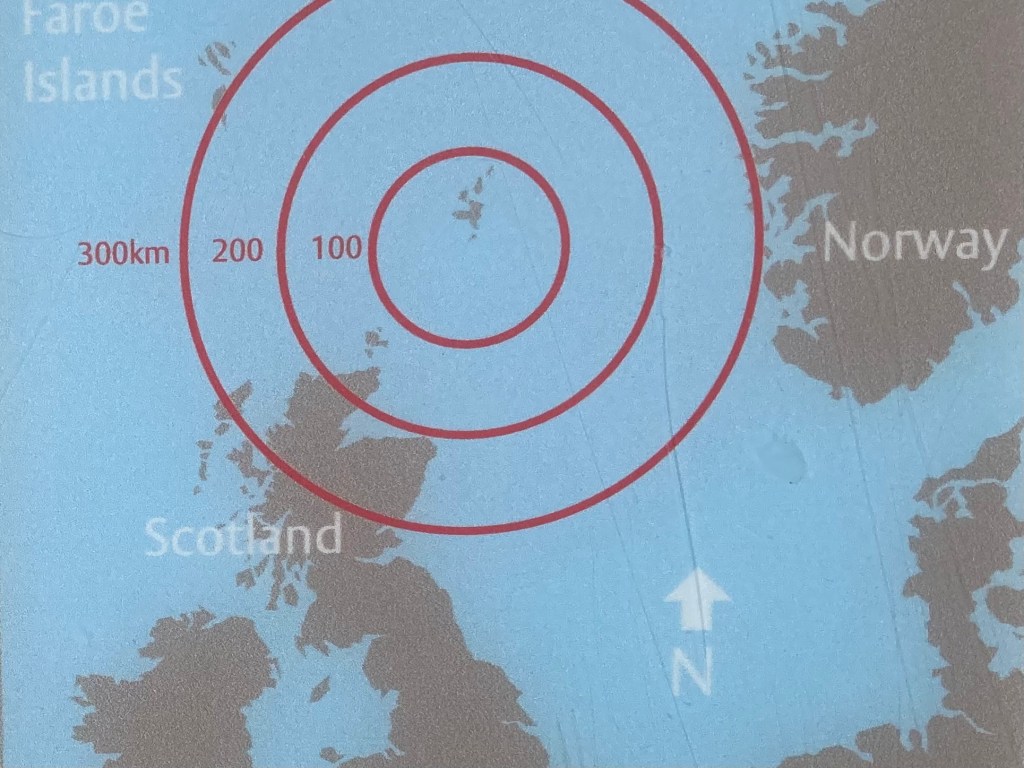
Thursday 5 June 2025
David dropped us at the station at 08.00 (he travelled the following day) and we had a uneventful journey to Gatwick, to catch an early afternoon flight to Aberdeen, followed by a bus into the centre, and a short walk to the conveniently sited Ibis hotel within easy distance of the ferry terminal. Oddly, decent beer and traditional pubs were in short supply in central and depressing Aberdeen, and as the Italian restaurant was empty and on the point of closing, we ate in a Brewdog outlet – better than we feared.
Friday 6 June
We had a long wait before boarding the ferry (scheduled to leave at 17.00) so we sheltered from the rain in the fascinating Maritime Museum, charting the history of Scottish fishing and sea-faring, and the North Sea gas and oil industry, before walking to the Esplanade, from where we saw a small pod of dolphins cavorting along the shore.
Lunch was in the still empty Italian, before we collected our bags from the hotel, and headed for the ferry terminal. We found our way onboard, located our unpromising pods and assembled on the rear lower deck while the ferry loaded cars and camper vans. Here we met Mark Wood, our tour guide, and fellow travellers, David, Debra, Sue, Sheelagh and Chris, and spent several hours of evening sea watching as we sailed North. (Note: many of the photos that follow are slideshows – so click on the arrows alongside)


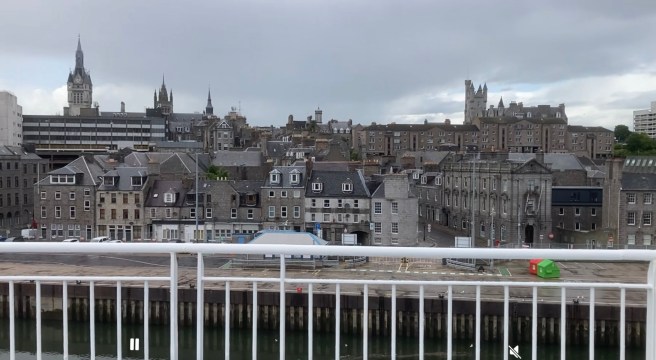
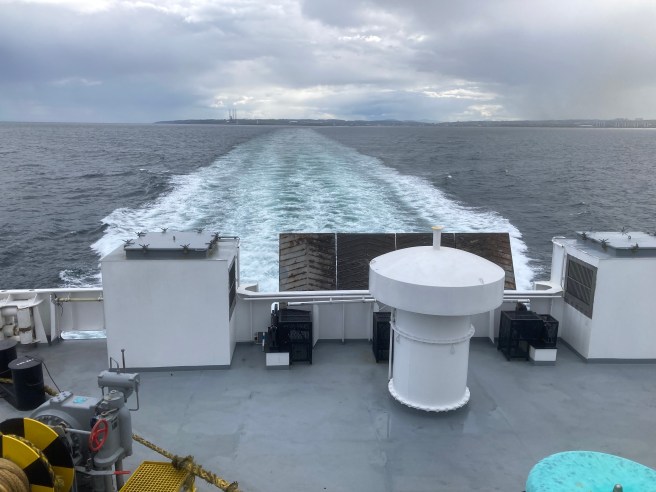
First stop at 23.00 was Kirkwall on Orkney; by 01.00 the decks were quiet. We had a pretty gruesome night ( not sea sickness – but pods are very unsatisfactory – Hugh slept on the floor of the main deck and I stuck it out in the pod… ) Food was OK; beer better. (Note for next time: get a cabin, or fly!)
Saturday 7 June 2025
We arrived in Lerwick, and by 07.45 had boarded the minibus, parked nearby. So far, so good….
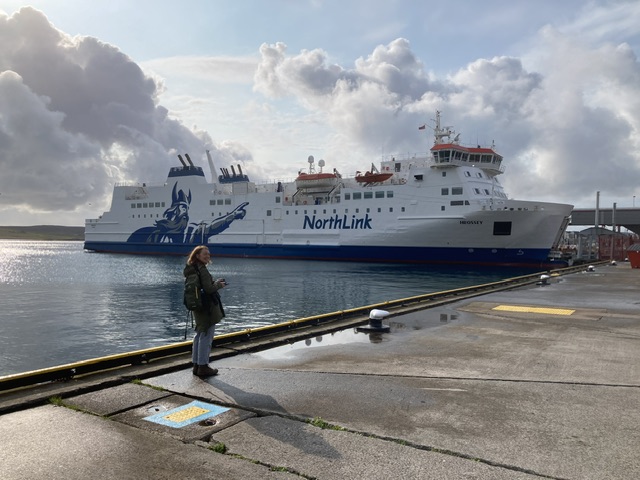
The plan had been to drive south to the Sumburgh Hotel to leave the luggage; instead we stopped off at the Lerwick Coop to buy some lunch, (prawn sandwich I) and then hurtled North to Yell in pursuit of the rare eyebrowed thrush, a native of Siberia, which had been sighted in a garden near the Gutcher ferry to Unst. After a drive of 45 miles I was very glad we spotted it! Other enthusiasts armed with very long lenses unsettled it, and we watched as it left the garden to disappear into a small quarry. It was already clear that Mark was very keen to make the most of our time….
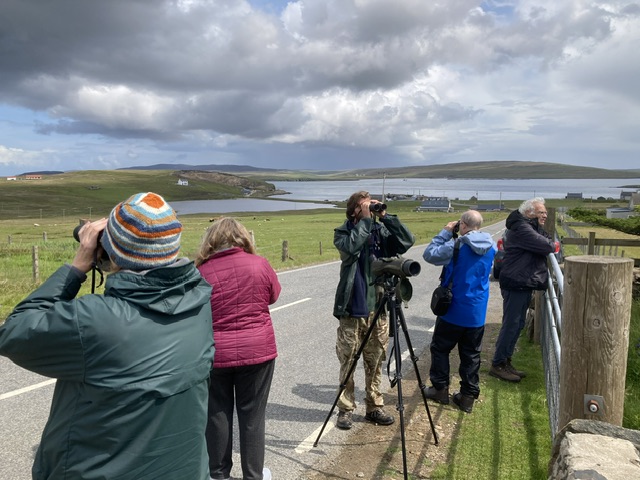
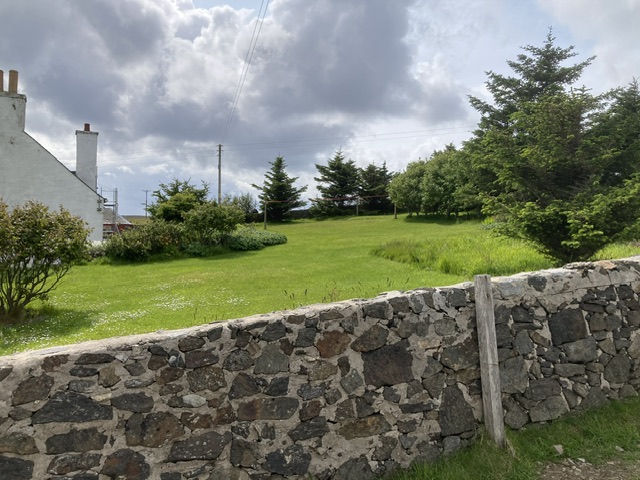
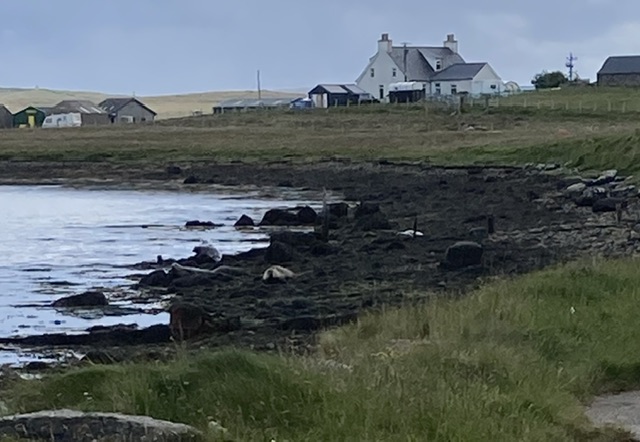
Mark then drove to Cullivoe, the most northerly point of Yell, where we ate lunch by the Gloup memorial (recalling the loss of four Sixareens (large, rowed fishing boats) and 58 Shetland fishermen in a terrible storm on 20 July 1881). Notice the bright weather ! And two grey seals lounging in the RH photo
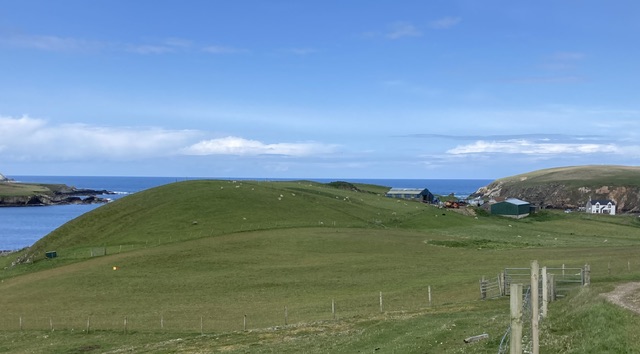
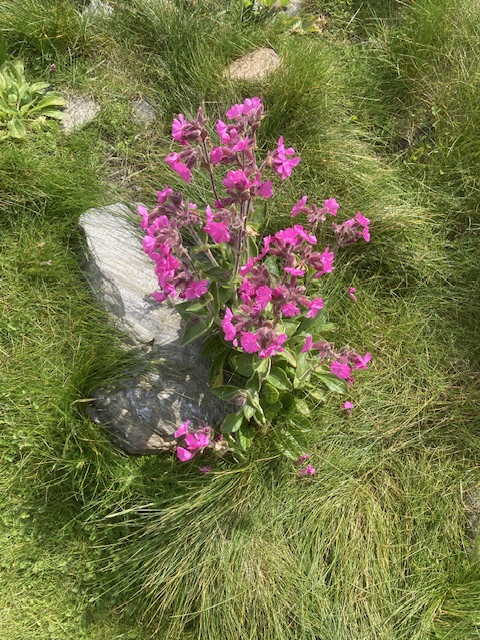
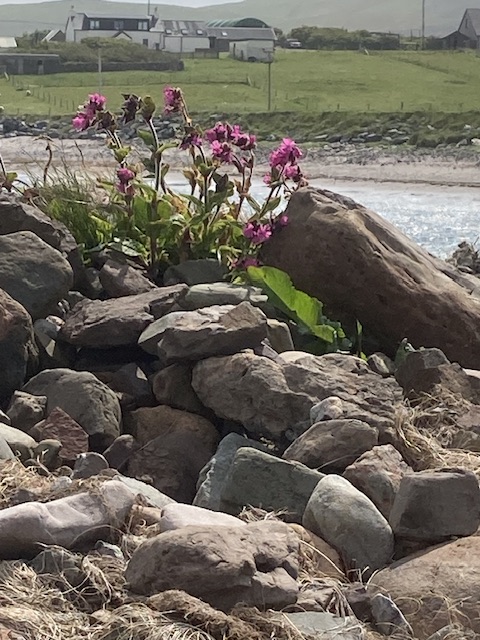
We drove south, the length of Yell, to examine inhabitants of the Loch of Littlester, and on to Burravoe where Mark’s botanical training led us to various orchids, spring squill and ragged robin.

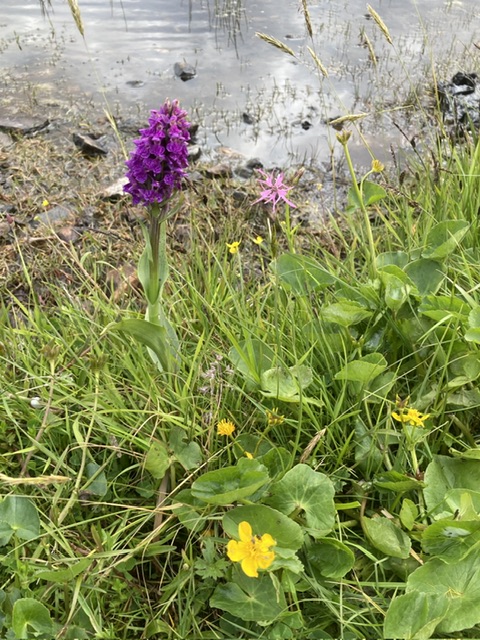
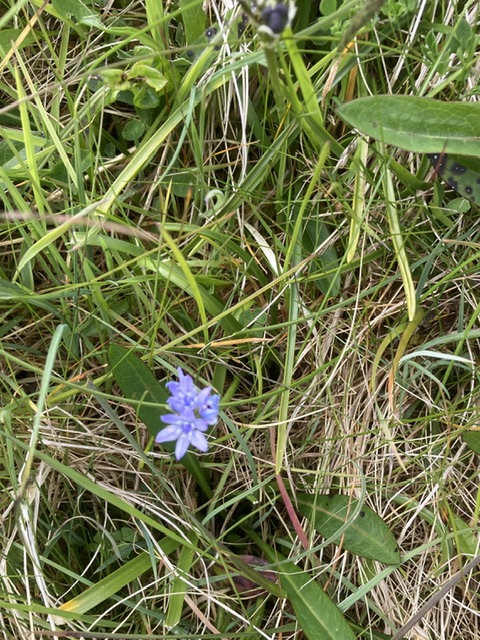
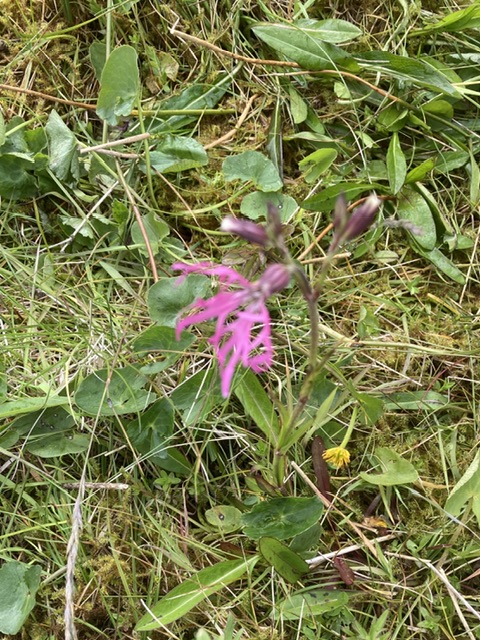
It was a long drive (54 miles) south from Burravoe to Sumburgh, via the Ulsta – Toff ferry back onto the mainland, during which we travelled through the landscape from almost top to bottom of the archipelago. It seems that nowhere in Shetland is more than four miles from the sea.
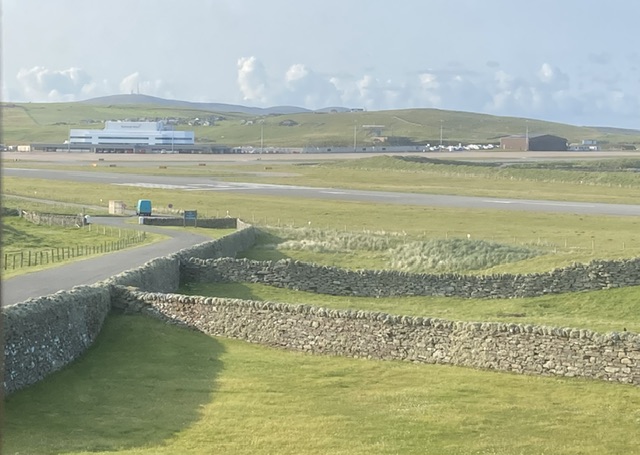
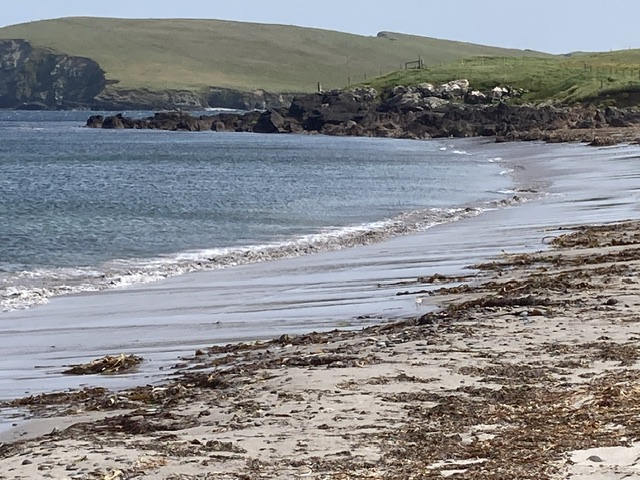
Sumburgh Hotel is fabulously positioned a mile from the airport (largely Loganair), alongside Jarlshof, an extraordinary archaeological site and a fine unused beach (see Thursday) with a view of a small harbour (Grutness) and walking distance to the Sumburgh Head RSPB reserve.
It caters efficiently for the needs of large numbers of enthusiastic birders, hikers and intrepid tourists with substantial traditional British hotel food cooked in-house, good service, functional rooms and pretty good beer. Below is the view from my room.

Sunday 8 June 2025
A bright morning – perfect for the visit to Sumburgh Head RSPB reserve

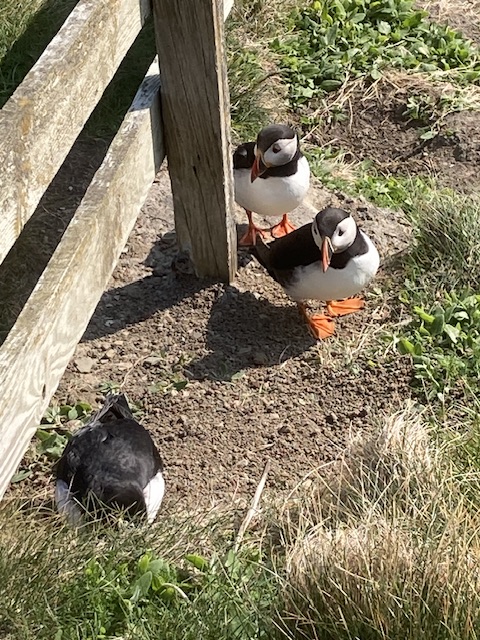
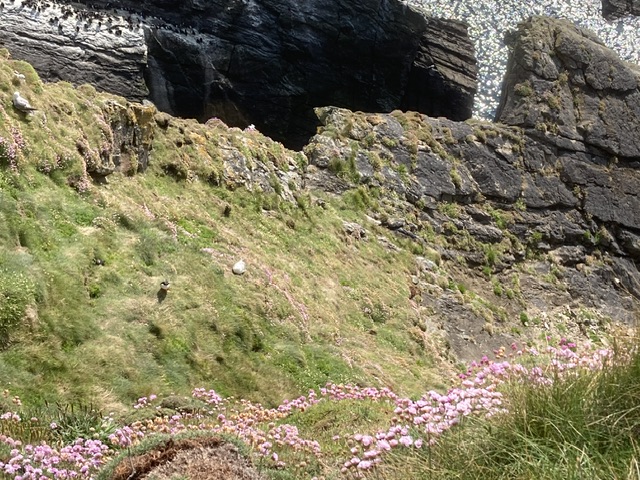

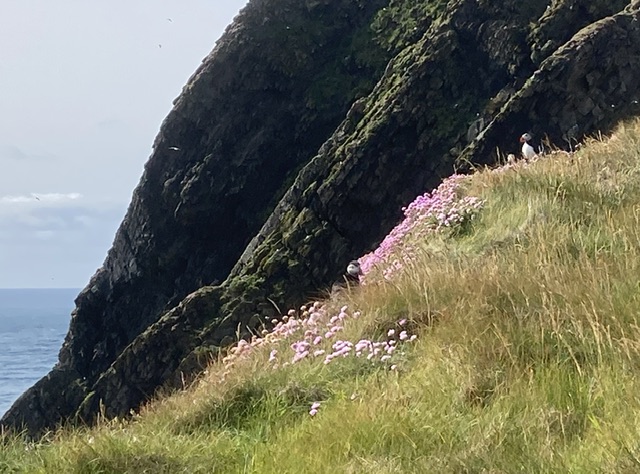
and the RSPB cafe with fine views and a brilliant business model – donations and self-service
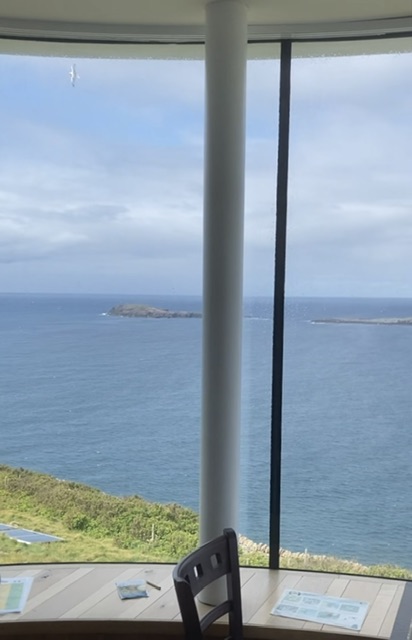
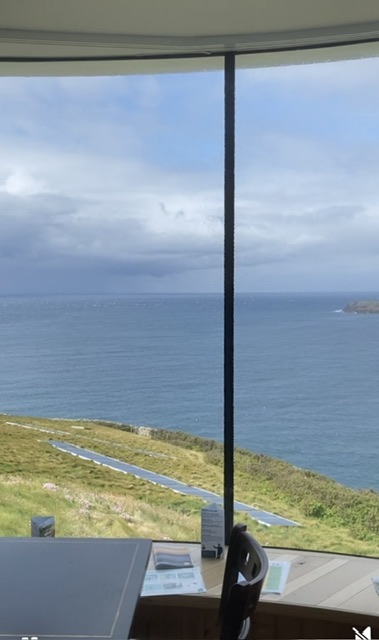

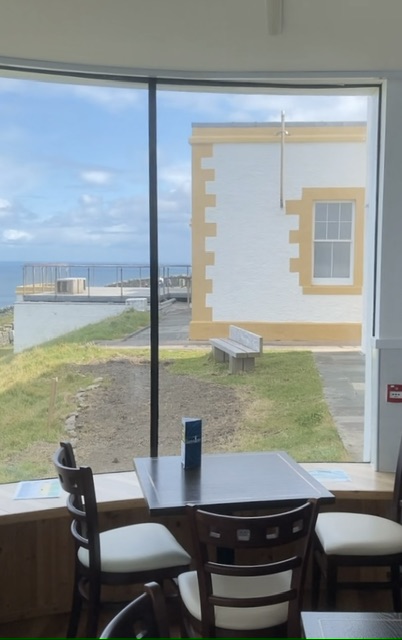
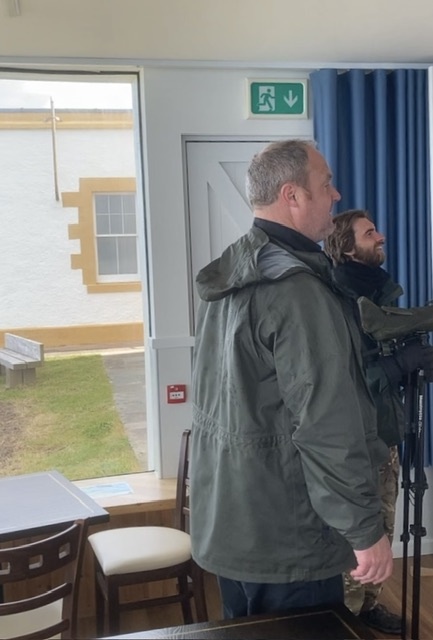
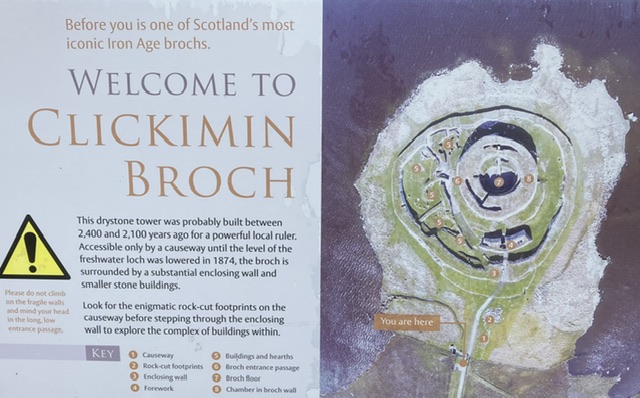
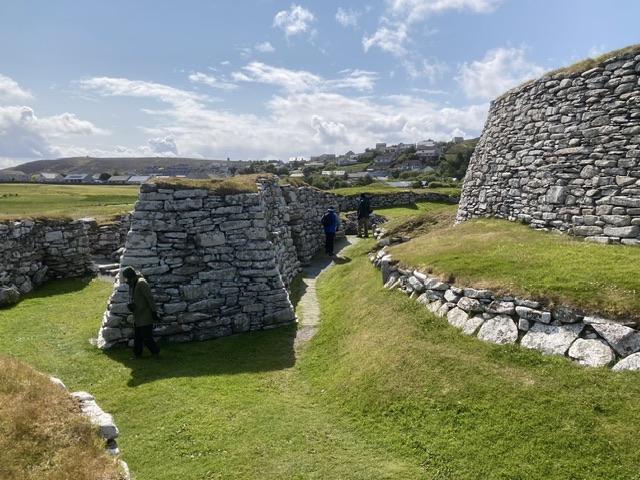
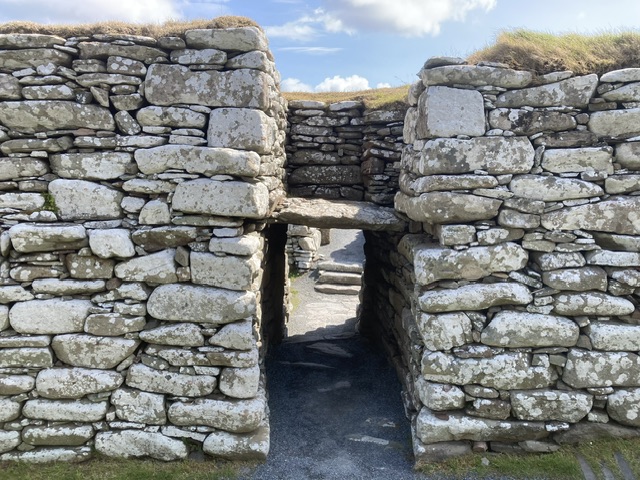
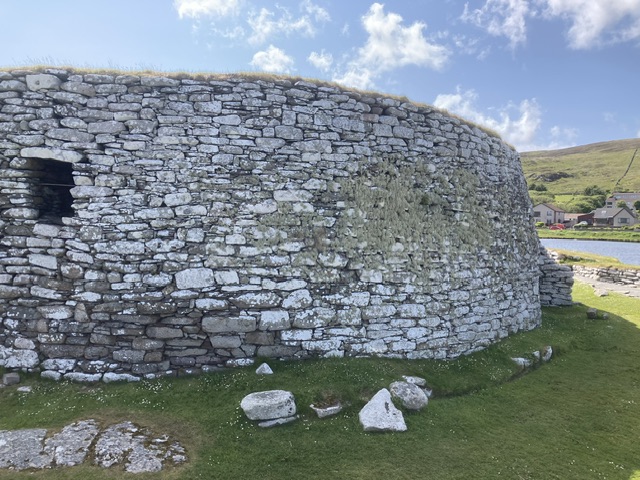
From here we drove the 25 miles to Lerwick (pronounced Lerrick) to buy lunch – this time from Tesco (prawn sandwich II) before visiting Clickimin Broch in the town itself, and within 200m of Shetland’s only if very large secondary school





To cap the day we boarded the private hire Shetland Bird Tours boat, piloted by Phil (from Manchester originally) which (had the swell been gentler) would have taken us well out to sea in the hope of spotting cetaceans. Instead we circumnavigated the island of Bressay, taking in the adjacent Noss, which is home to an enormous Gannetry and thousands of Auks (Guillemots, Puffins and Razor Bills).
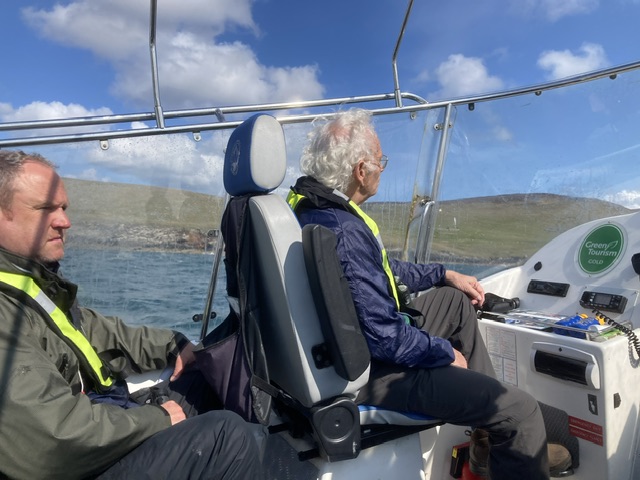


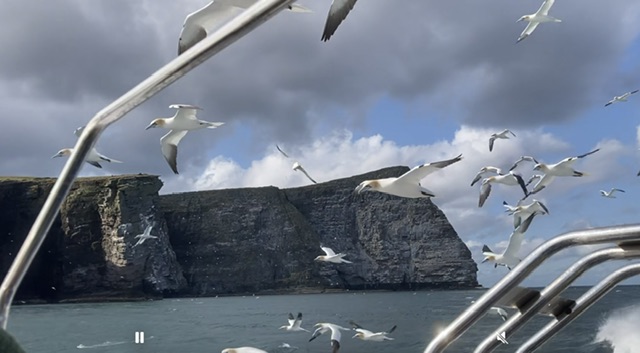
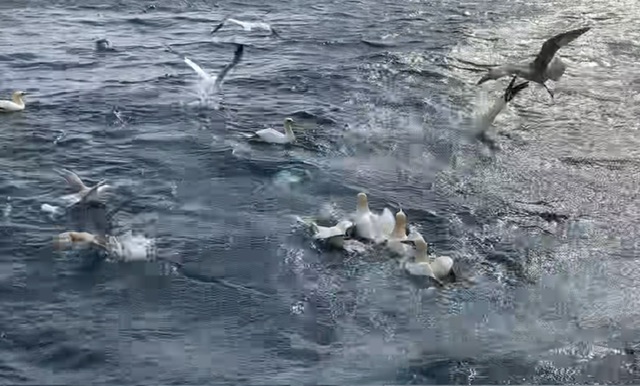
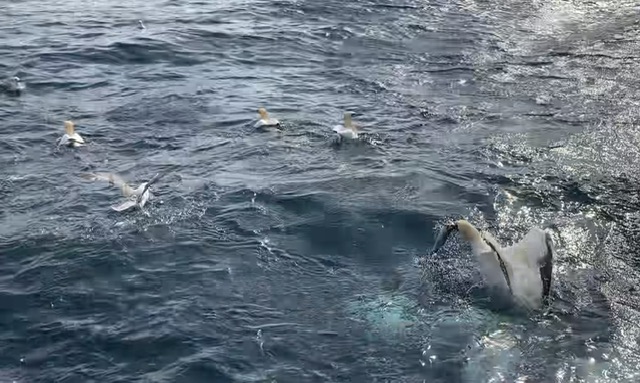
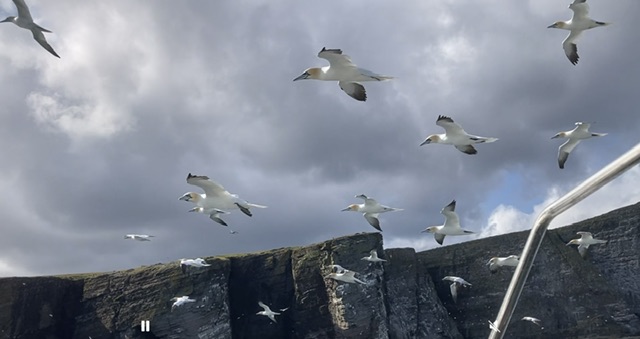
These outings are undoubtedly popular with the birds: on the return journey they escort the boats in their hundreds in order to dive for the fish liberally thrown for them. It was an impressive sight – but not as gripping as the sights and sounds of their nesting cliffs, photos of which will follow on Tuesday.
Monday 9 June 2025
This was the only day when we experienced some intermittent drizzle – and very strong cool winds. After a stop at Quendale bay, we drove to Mavis Grind – the name of the tiny strip of land which joins the large Northmavine to the central mainland. It has the Atlantic Ocean on its western side and the North Sea to its east. Photos: LHS – North Sea; RHS Atlantic
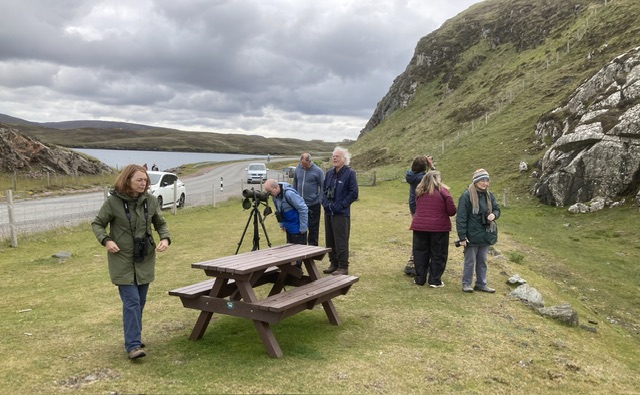

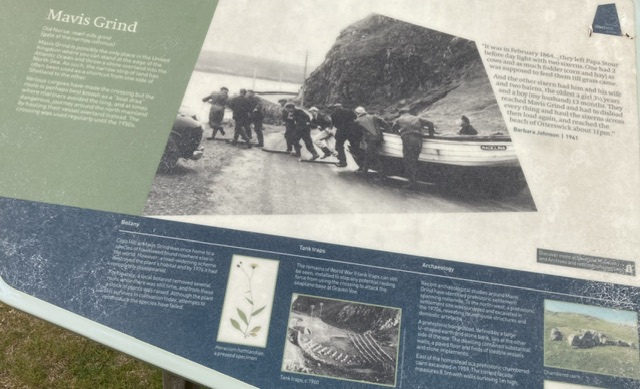
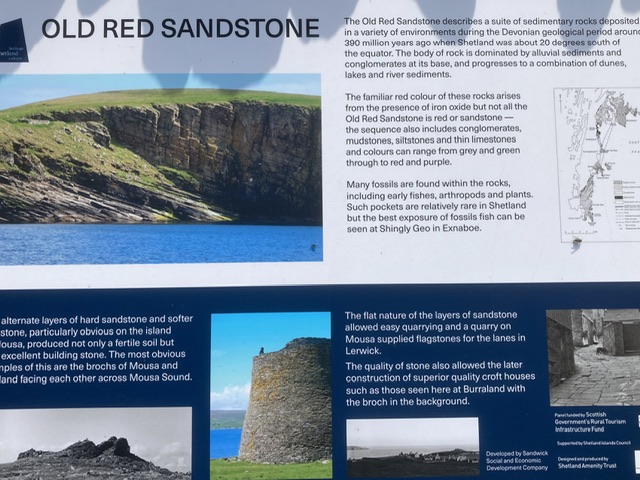
The Shetlanders go to a lot of trouble to inform, explain and educate. Here we could read about the practice of dragging fishing boats across the causeway (to avoid a day’s rowing around Northmavine)
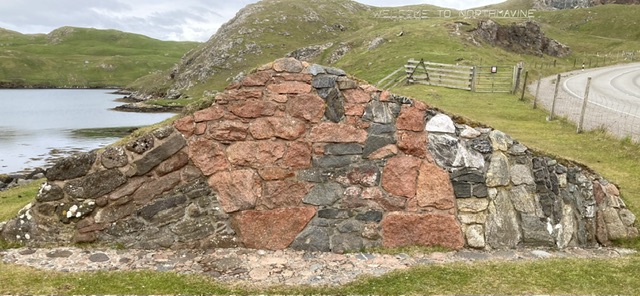
and the geological makeup of the local landscape. Notice the helpful ‘wall’ mirroring the diagram.

We drove onto Hillswick where we spotted an otter on the rocks of the bay – shortly before an untethered dog frightened it away from the beach
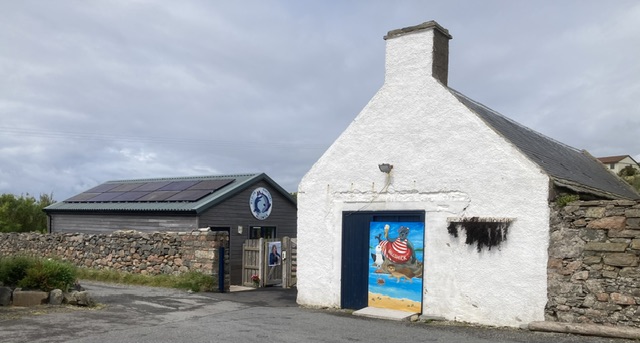
Then we drove on to Tangwick at Eshaness, to admire the coast and lunch (prawn sandwich III)
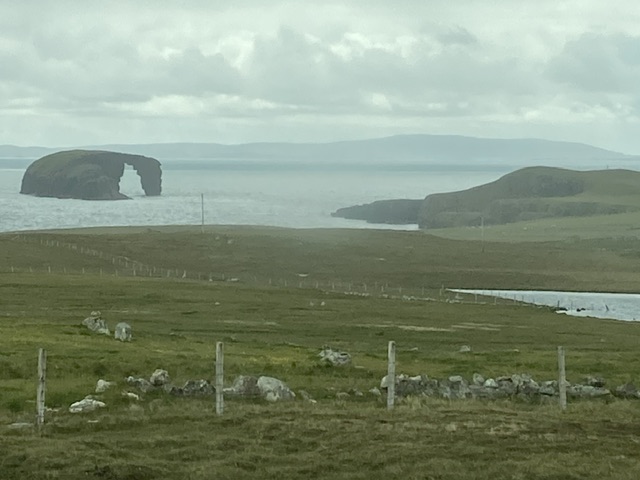
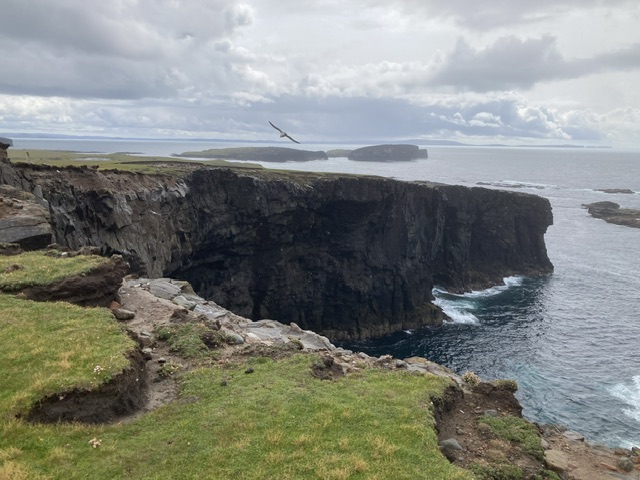
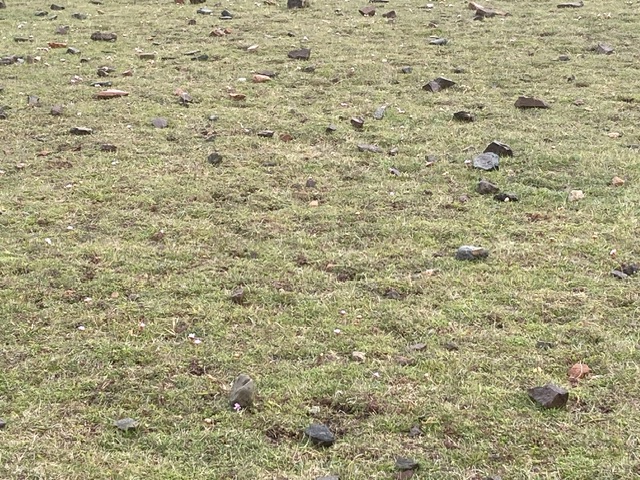
and to see the extraordinary stones thrown up onto the cliff top in raging seas (the wind was very fierce here, and the skies grey) and to capture more views of the massive skuas.

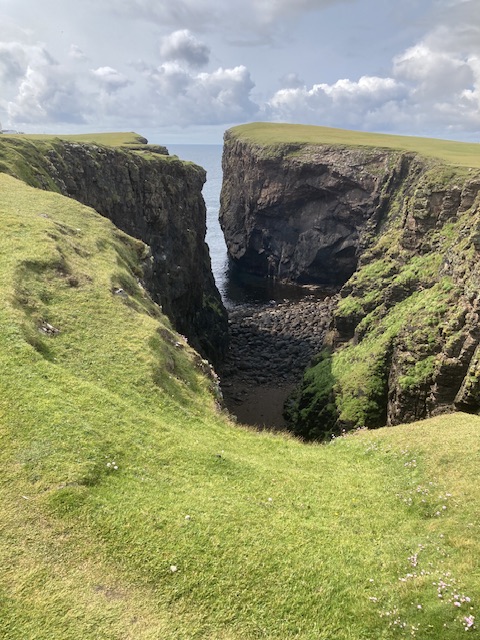
The weather cleared as we walked on to see the Eshaness Geo – a massive ravine, running at right angles from the cliff line for 100s of metres. A former colleague tells me that ‘a Geo is formed on high-impact coastlines where waves exploit weaknesses in rocks that are aligned in bands along the coast. In some cases you may get a cave, but the geology here means that they collapse before they form’.

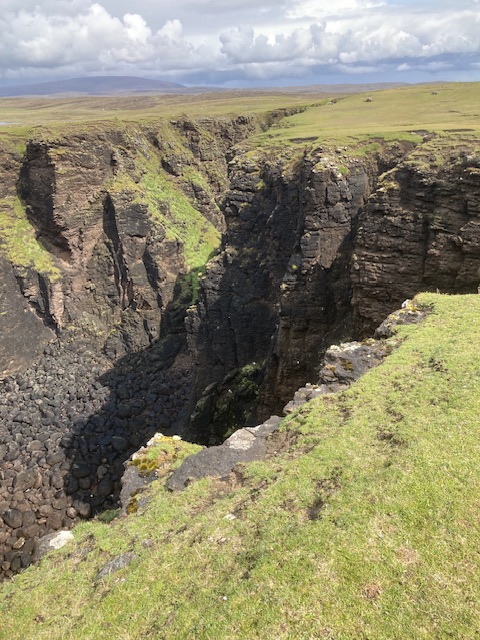
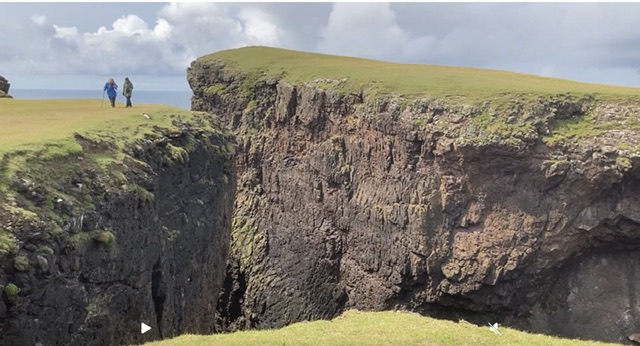
And I was equally gripped by the lichens, which clad so many rock surfaces everywhere


We ate an early supper at the hotel – and by 21.00 we had set off for Sandwick, about ten miles north along the east coast from Sumburgh, to join the Mousa boat, which at 22.00 conveys up to 60 enthusiastic birders from the mainland onto the uninhabited Mousa. Half a mile from the landing stage, the six feet thick outer wall of the Mousa Broch rises up 50 feet, providing an impenetrable and secure space for hundreds of breeding storm petrels. We returned to the hotel at 01.30 on Tuesday after a fantastic midnight expedition.
Despite the time, there was still enough light to walk by – just! (The photo below was taken in daylight!)

These small birds spend their entire life at sea, only coming to land to lay a single egg (no nesting material) and the pairs take turns to incubate it while the other fishes. Their return in the dusk (between 23.00 and midnight) in their hundreds is remarkable; avoiding the predatory skuas and big gulls, like bats, circling and swerving, and calling to their mates. Their legs are far back, evolved for swimming not walking; they scurry and crawl between the stones. Learn more at Mousa.co.uk/storm-petrel-trip
Tuesday 10 June 2025
A late start gave opportunity to photo the hotel’s surroundings, including the Jarlshof archaeological site

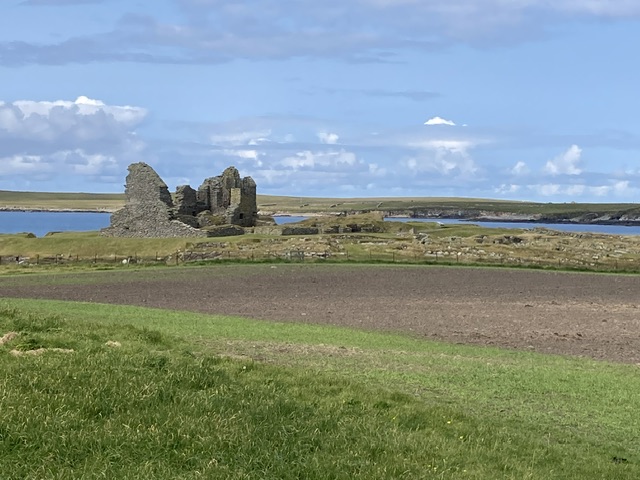
We set off for Tingwall, ‘field of the Parliament’ situated between Scalloway to the W and Lerwick to the E, where until 1602 the Shetland Assembly met on a small spit of land called Tingholm, in Tingwall bay.
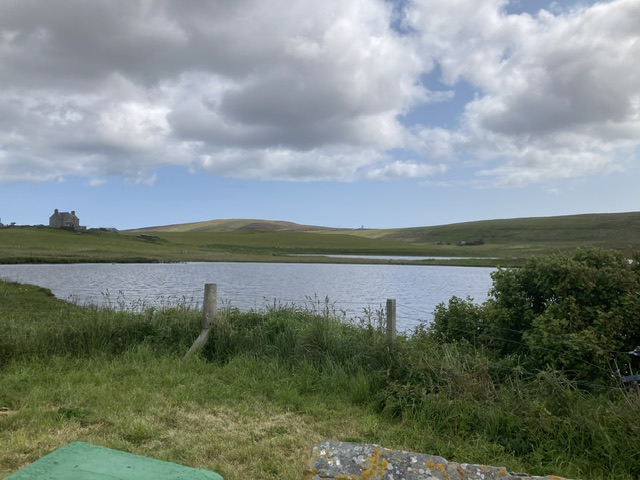
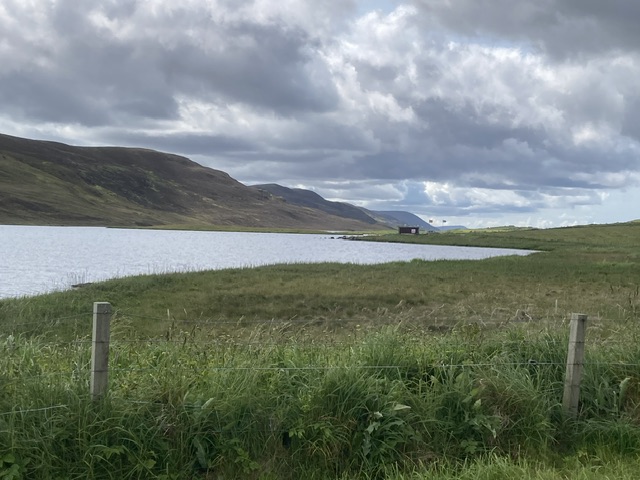
After 1602 the Assembly moved to Scalloway, a few miles away, which is a pretty and relatively busy small town and harbour, with a small hotel The Cornerstone and a cafe, alongside the car park and loos, and next to a hand-made woollen goods shop and a handsome large house.
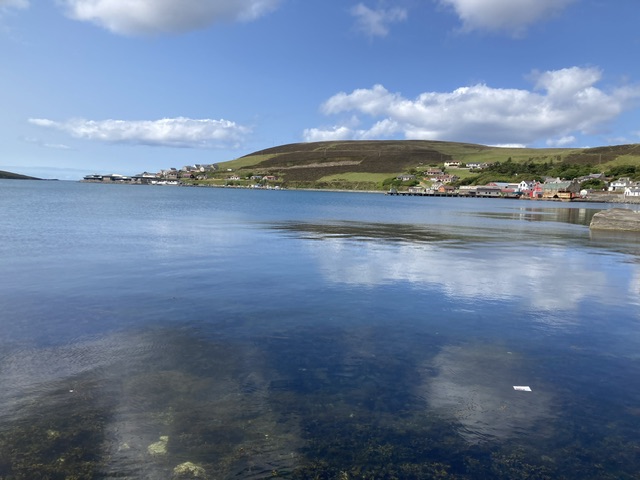
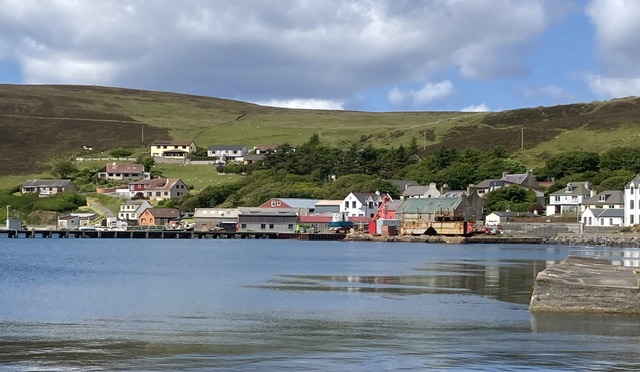

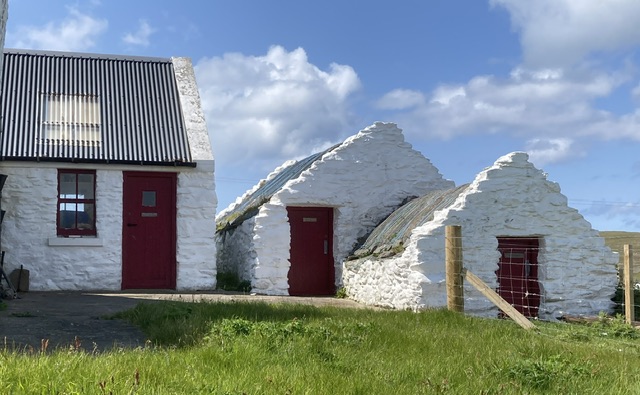
We moved on to a small settlement called Duncansclett on West Burra to the south of Scalloway, where several old houses or crofts remain; one or two still under thatch (reed, not straw) but many now under corrugated iron. Alongside was a good example of a popular style of pre-fabricated building seen all over Shetland made from cheerfully painted overlaid wood; in this case, red.


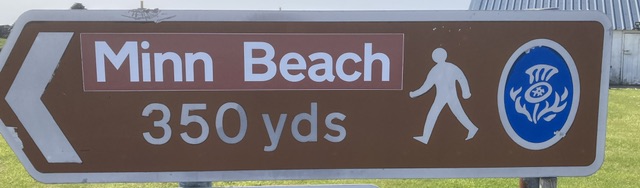
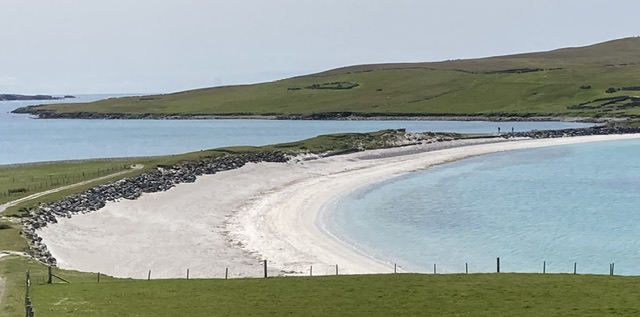
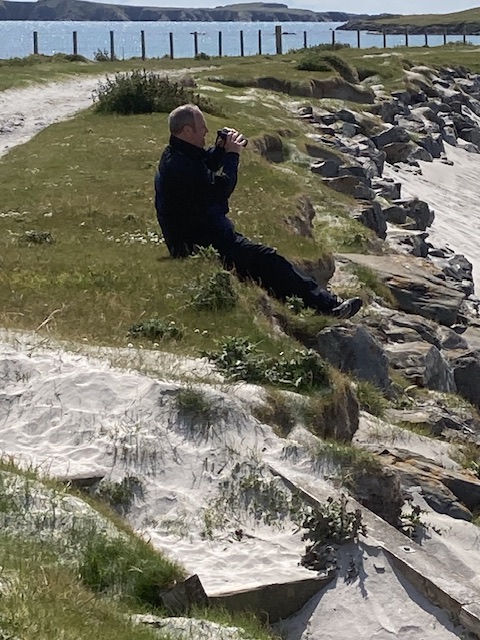
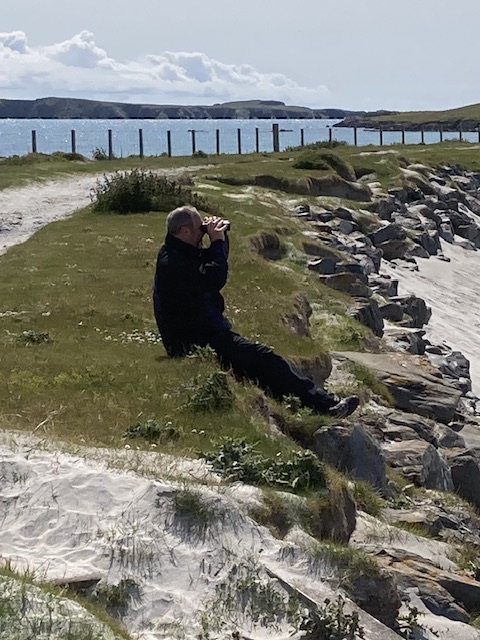
We walked from these houses down an unmetalled road to be confronted with the fabulous view of an empty Minn beach in bright sunshine, bathed by shallow tidal caribbeanesque water




We drove back to Lerwick to join a second boat tour of the islands of Bressay and Noss. This provided extraordinary views of Bressay’s lighthouse, built in 1858 by two of the third generation of the enterprising and busy five-generation Stevenson dynasty : David (1815 – 1886) and Thomas (1818 – 1887). An older brother was involved in the business; Alan (1807 – 1865)

Their father Robert was the step son of Thomas Smith (1752 – 1815) who was the very first engineer to be commissioned by the Scottish Lighthouse Board, and who created the first Lantern (by burning whale oil and using prisms and lenses) to shine for the first time on 1 December 1787, at Kinnard Head in Fraserburgh, to enable safer sea-faring.
Robert was responsible for many lighthouses, including Sumburgh’s lighthouse, built in 1821. His son David had two sons: the fourth generation: David A, and Charles; and finally Charles had one son, D Alan, who died in 1971, who was also a lighthouse engineer until his retirement in 1952. A remarkable family with a unique legacy.
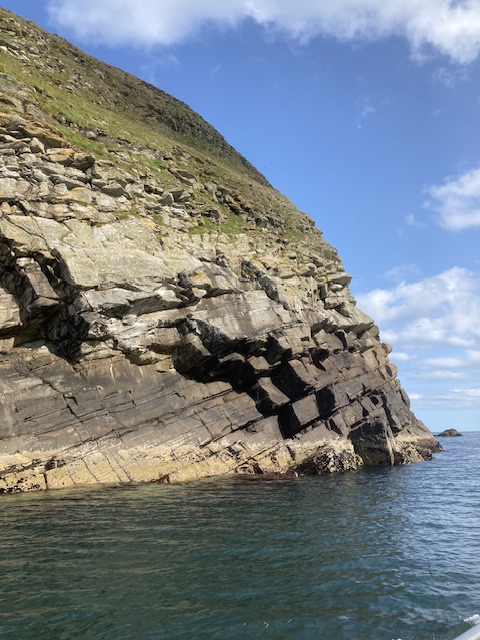
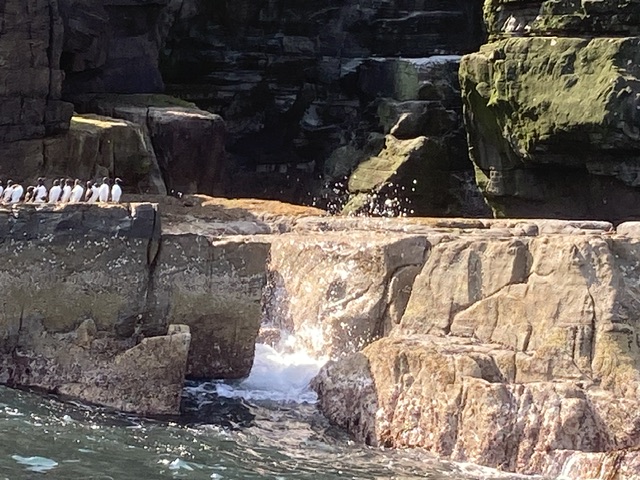
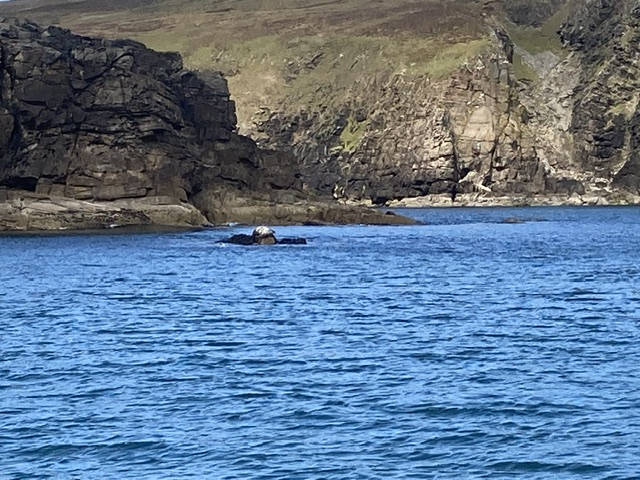
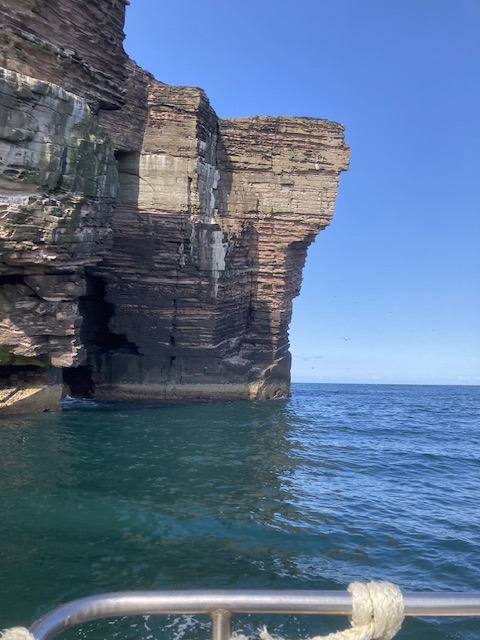
The boat skirted the cliffs of Bressay, providing stunning views of sheer rock faces with strata from myriad geological eras, in stunning colours. It was breath-taking to see.


We rounded Bressay, and headed across the sound towards Noss
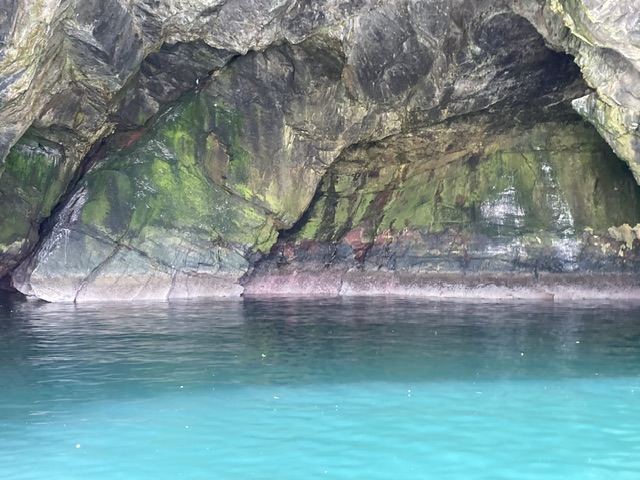
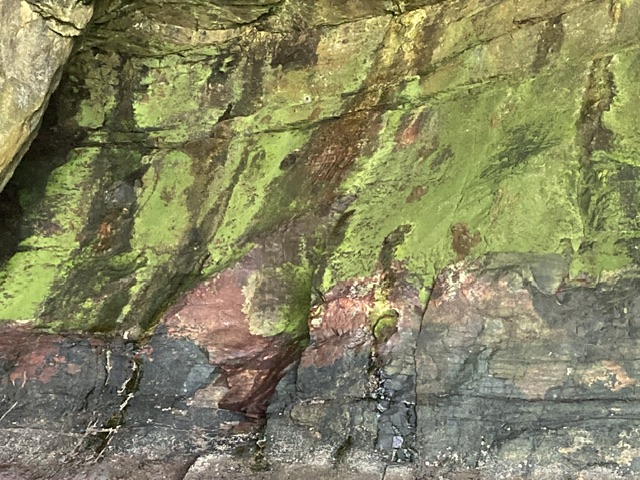
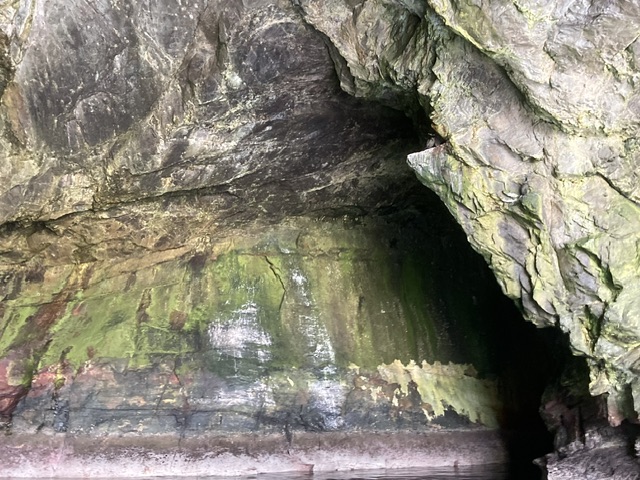
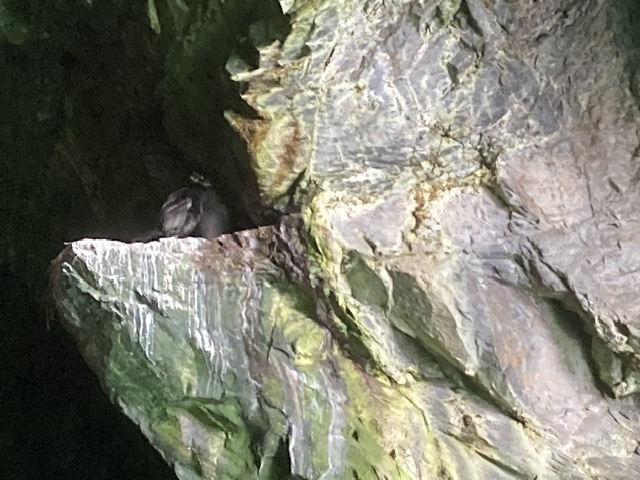

We could see and hear the colonies of nesting birds at this very important RSPB site

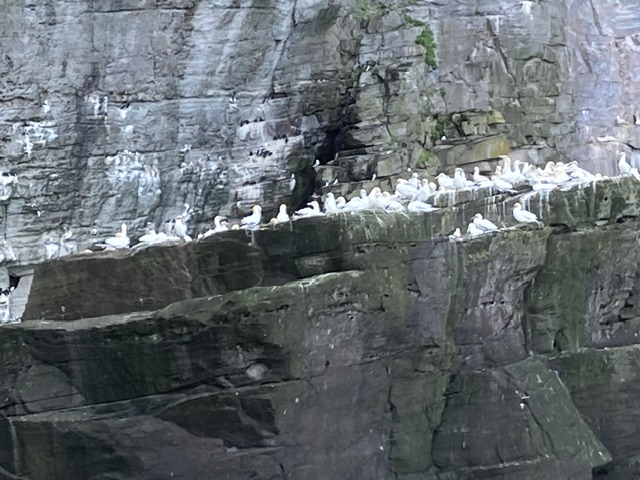
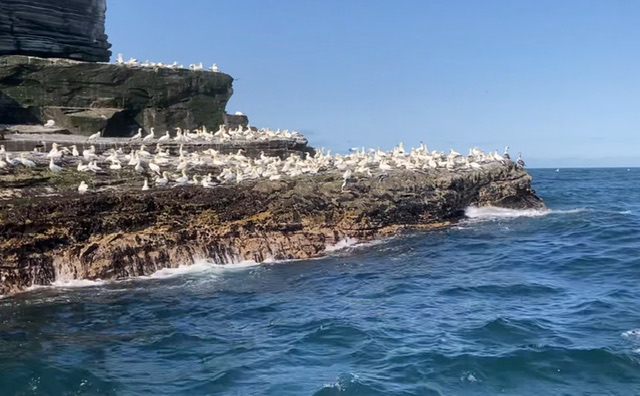
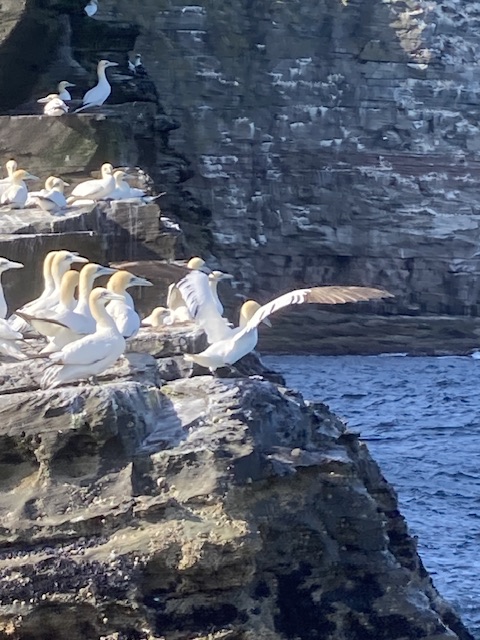
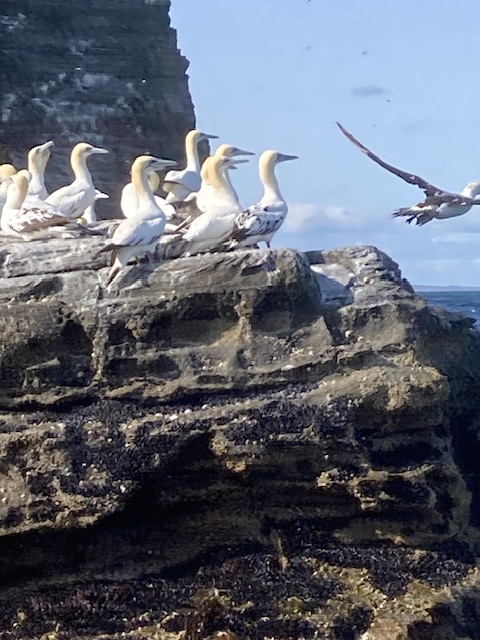
It was a spectacular sight. This boat repeated the throwing of fish to the accompanying gannets as we made our way into quieter waters, for a cup of tea (vacuum flasks) and some local history. Yes, Shetland ponies were bred and raised on this virtually uninhabited island, and yes, after they had been rounded up and haltered, they swam the Sound as a herd, towards the mainland, to be shipped to Tyneside to work in the coal mines of County Durham.
It was a wonderful day with spectacular sunny weather, even if the wind kept temperatures in the low teens. Boat journeys require many layers: I wore six for the nighttime Mousa boat, but only four today!
Wednesday 11 June 2025
Travel to Unst requires two ferry excursions needing careful timing: one from the mainland to Yell, and then on yet further north to Gutcher (of Saturday’s eyebrowed thrush excitement) for the ferry to Belmont. We were heading for Hermaness, the most northerly point of Shetland, which overlooks the extraordinary Muckle Fugga lighthouse (built in 1854 by David Stevenson) more than 80 miles north of Sumburgh – Shetland’s most southerly point – and our starting point.
En route we were in pursuit of a Pallid Harrier, reported to be on Unst at Uyeasound. On this occasion, we drew a blank. The Shetland sheep (note its very large head) was uninterested.

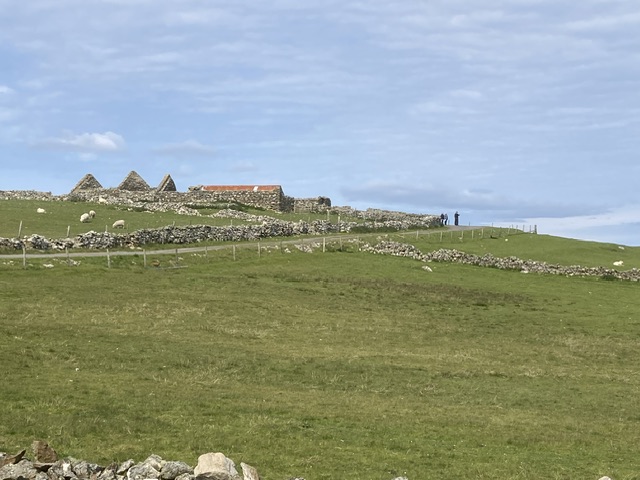
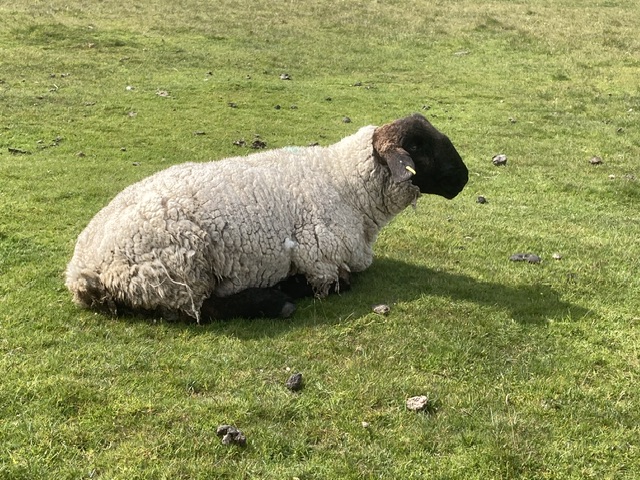
We drove on and on, eventually making it to Hermaness nature reserve, where the path across a slow incline leads eventually to the cliffs and a yet more impressive gannet nesting site. Hugh went in pursuit of red-necked phalaropes reported to be nesting in the bog pools on the cliff’s plateau.

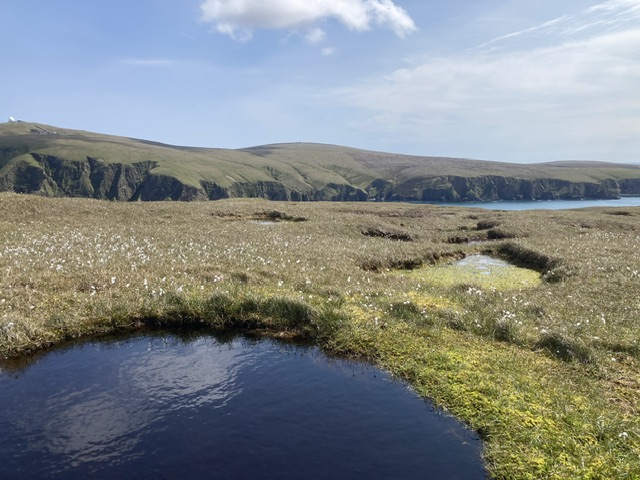
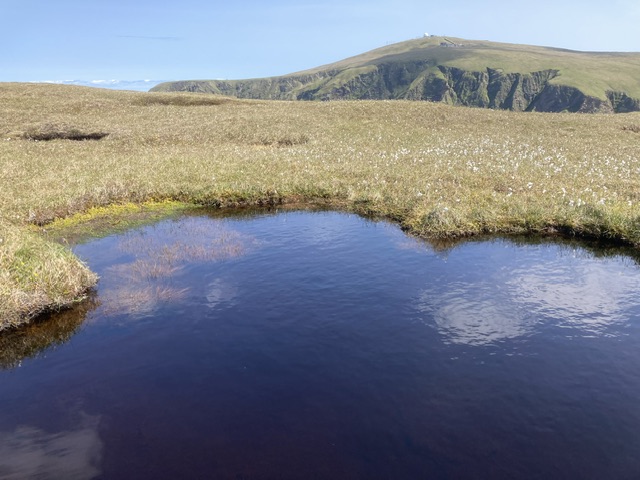
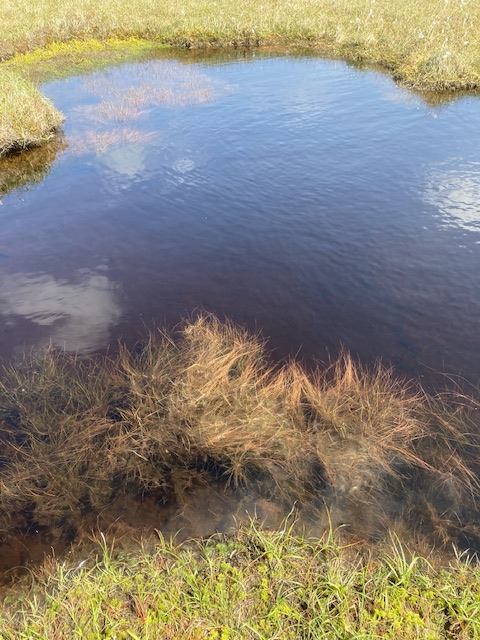
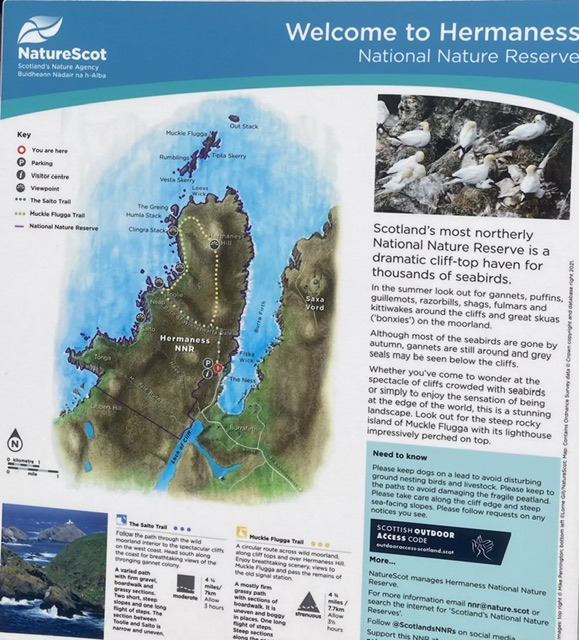
We caught up with rest of the group in time to eat lunch (prawn sandwich IV) and to get a glimpse of Muckle Flugga, the notorious lighthouse perching on a small rocky outcrop, built by David Stevenson in 1854 (and on which my sister’s husband served in the 1980s in his capacity as relief keeper.
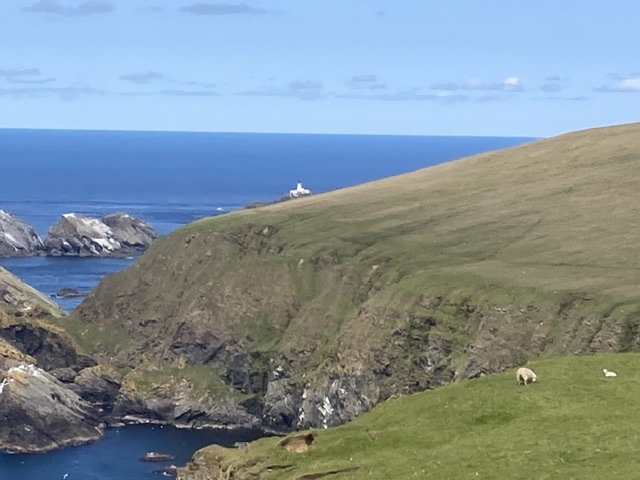
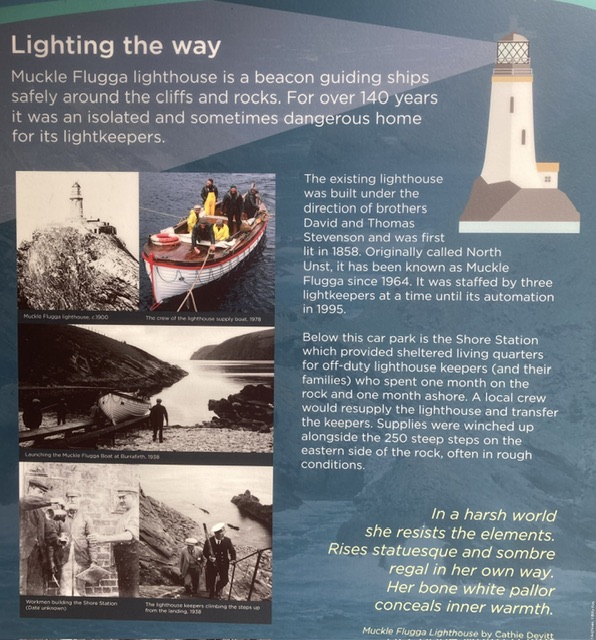
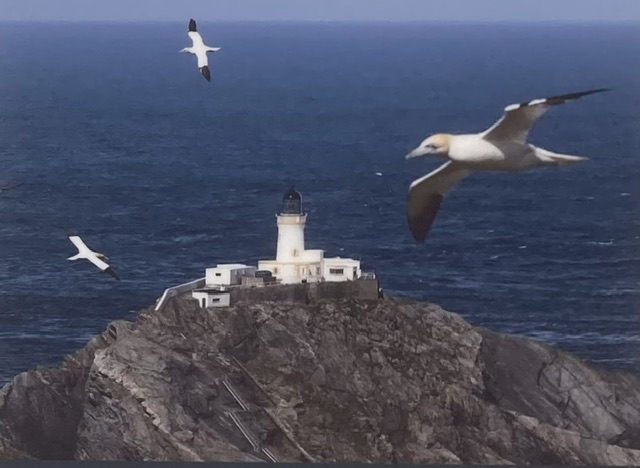
The sharp-eyed will realise that the RHS photo could not be mine. The LHS one is!
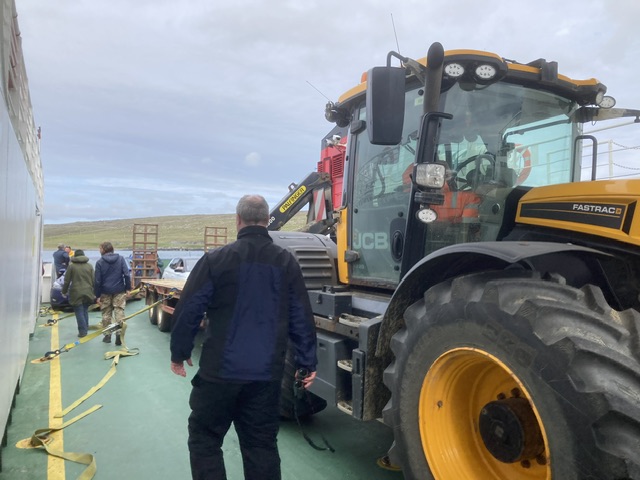
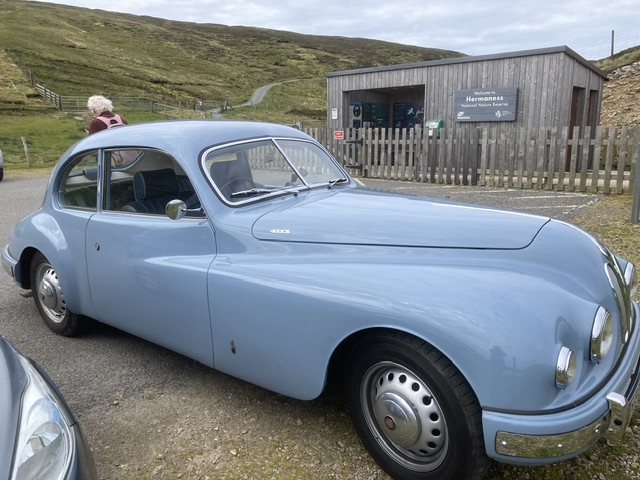
The journeys were punctuated by vehicular distractions. It was quite a surprise to see a very large tractor and trailer on the ferry with us; the Bristol classic car also seems incongruous…and Mark was ever vigilant, scouring the water for surprises…The long ship was well, long…and on land.
We visited Skaw and Lund in search of specials, strays and oddities. Mark never let up! We also scoured the Keen of Hamar, in search of the elusive and endemic Edmondston’s Chickweed (Cerastium Nigrescens). This field is in a special conservation area which Mark had surveyed intensely in his student days. This plant is found nowhere else in the world; nor could we find it here….on this occasion.




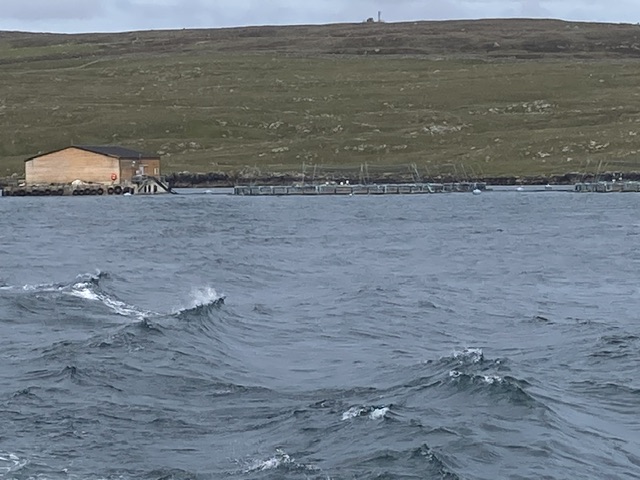
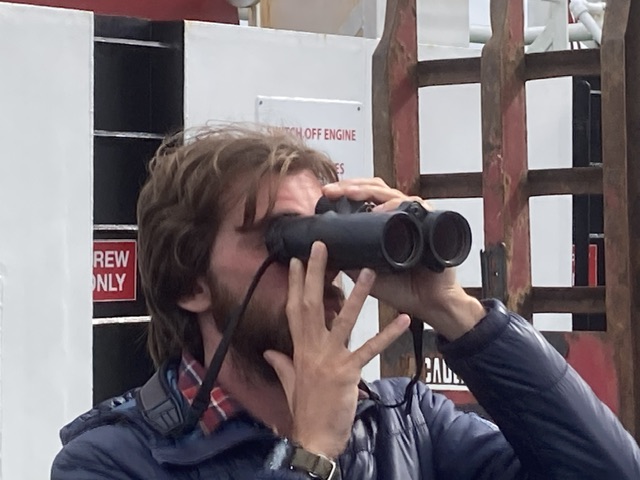
Thursday 12 June 2025
A gentler day began in the Central Mainland’s Kergord woodland which is a modest collection of trees, planted initially to protect the house from the continuous wind. Migrating birds find some protection here, and some woodland birds have taken up residence, but familiar garden birds are in short supply.


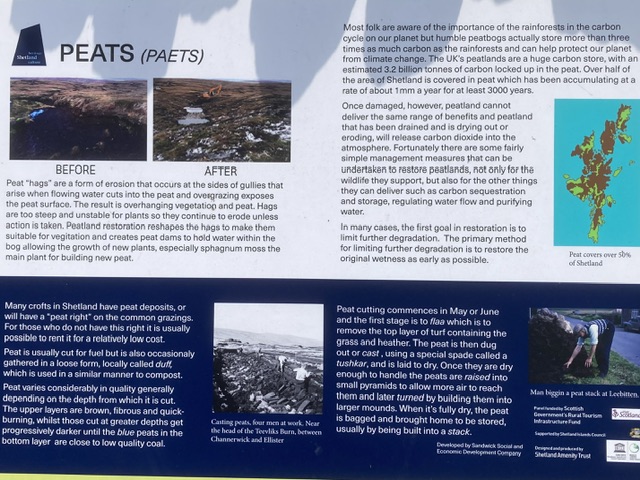
It was a frustrating day for birders, for the wind made listening for birdsong difficult, which then inhibited sightings as we moved on too soon. I enjoyed the variety, and the landscape fascinated me. For example, peat cutting continues, for use as a fuel; we passed deep trenches and carefully arranged drying stacks
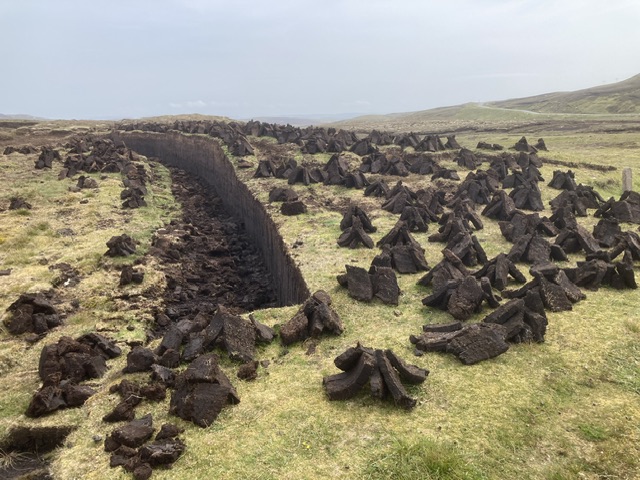


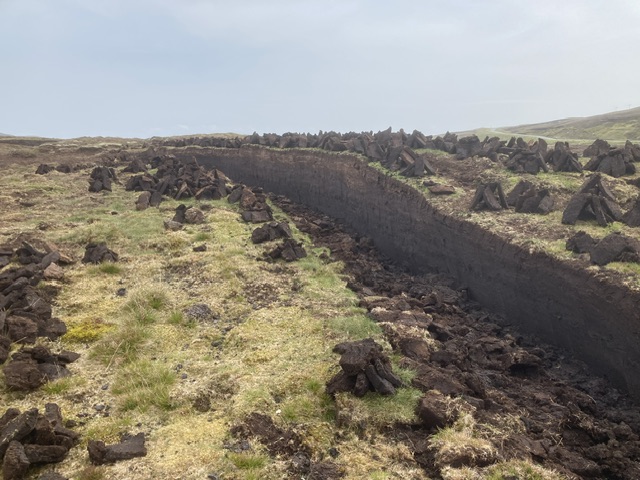
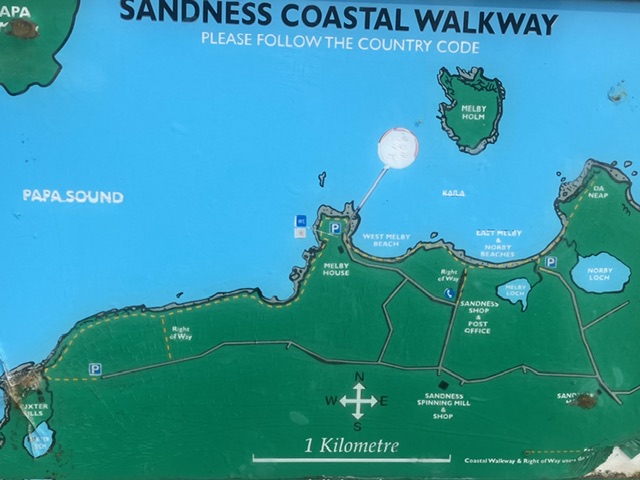
We moved from Kergord to Sandness, at the northwestern end of the West Mainland, and spent time in search of a Great Northern Diver, reputed to be in the area. At the Bridge of Walls, we watched a dog otter fishing energetically and very successfully at the point at which the river joined the tidal estuary.
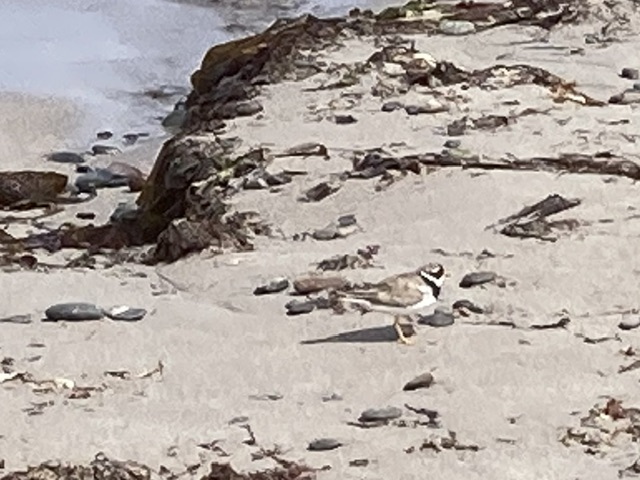
We were in sight of Papa Stour Island, and several ring plovers on the shoreline. At every opportunity – from the boats, the ferries, the cliff tops, the bays and beaches – we had scoured the waves in search of cetaceans – unsuccessfully. Dolphins, Porpoises, Minky whales and Orcas were in very short supply…

We returned to Sumburgh in time for some of us to visit the Jarlshof archaeological site alongside the hotel. Neolithic people first settled here around 2700 BCE, and it remained in use until the 1600s CE. A great storm in the late 1800s uncovered evidence of extensive settlement, and as the site was excavated it became clear that the domestic and defensive arrangements of many different eras were represented.
oval-shaped Bronze Age homes, complete with grinding stones

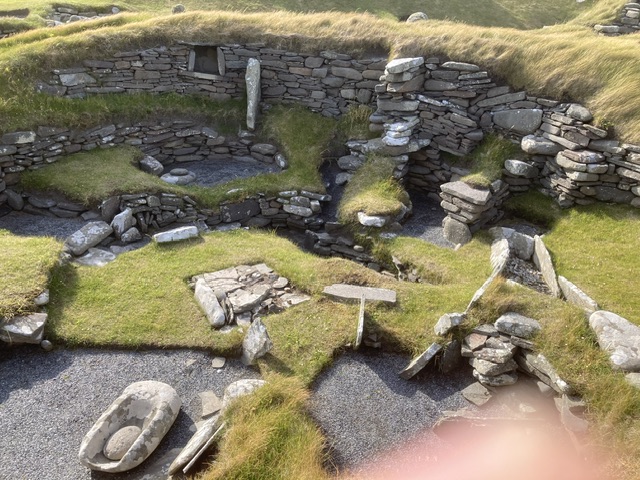


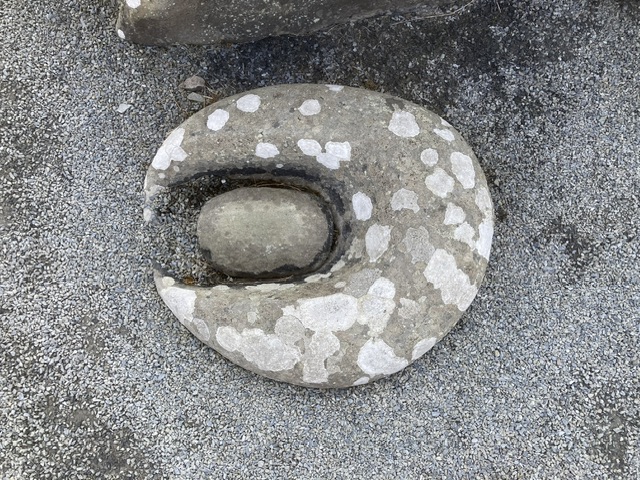
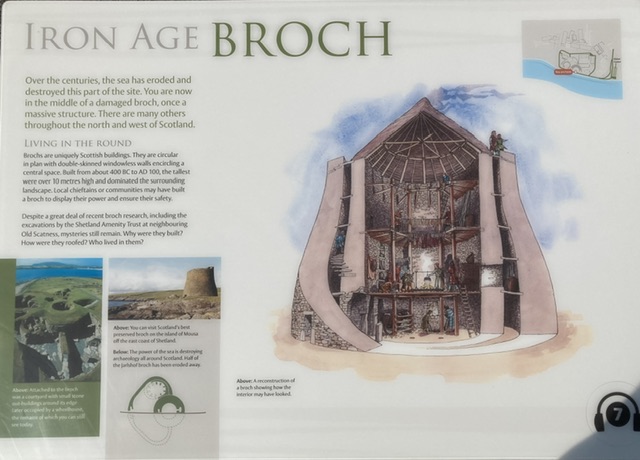
an elaborate Iron Age Broch and wheel houses (some of which have now been lost to the sea)
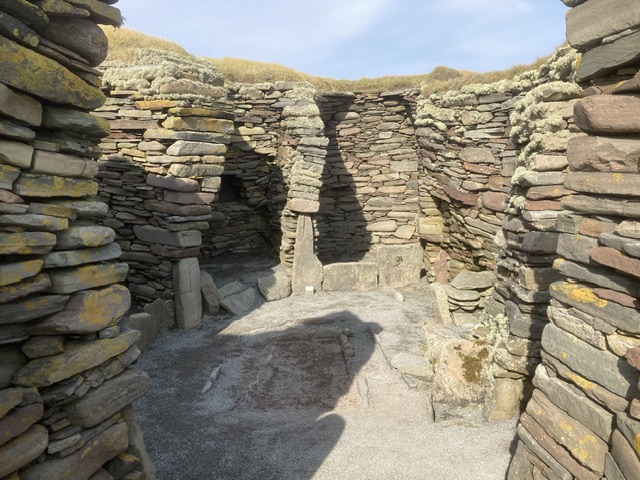

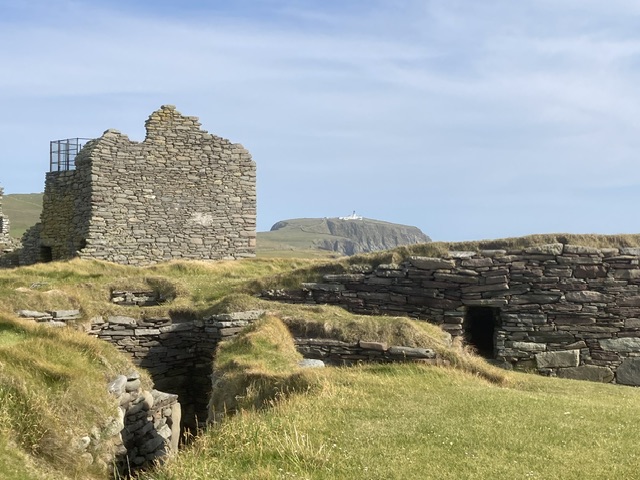
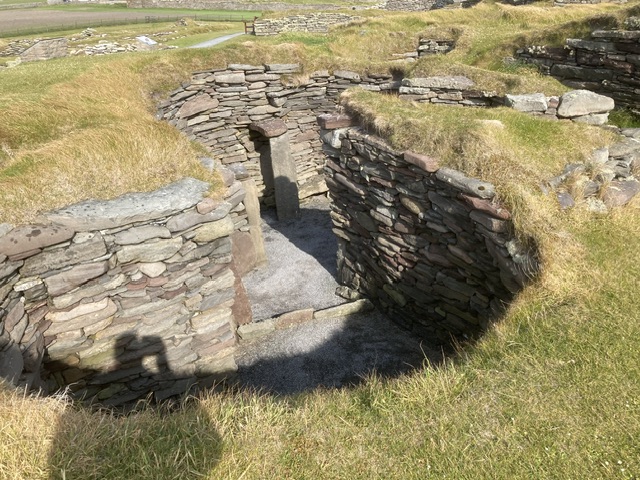
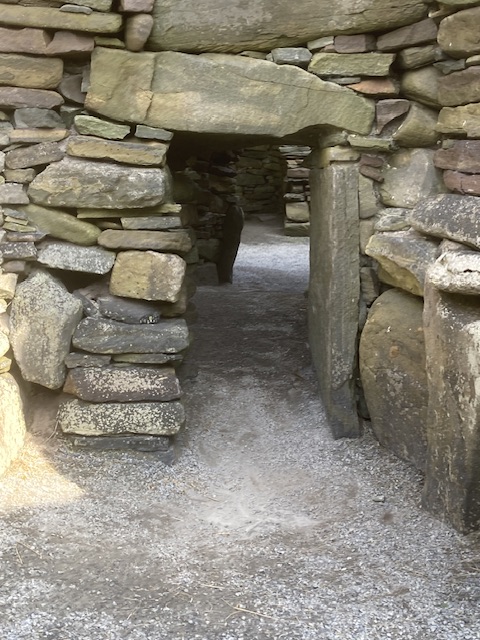
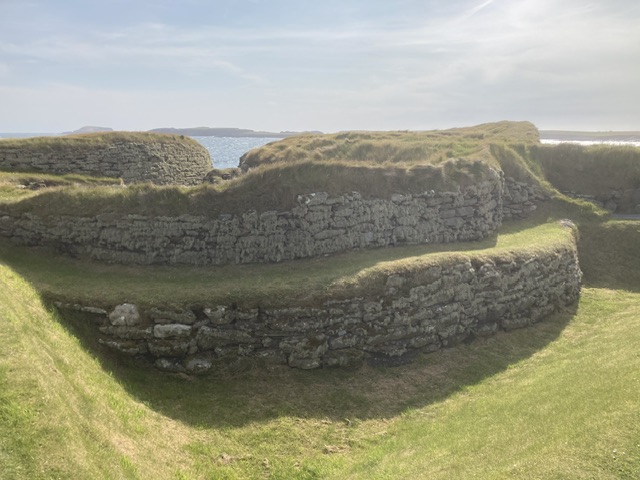
Norse longhouses (built in stone in the absence of the Vikings’ favourite building material – wood)
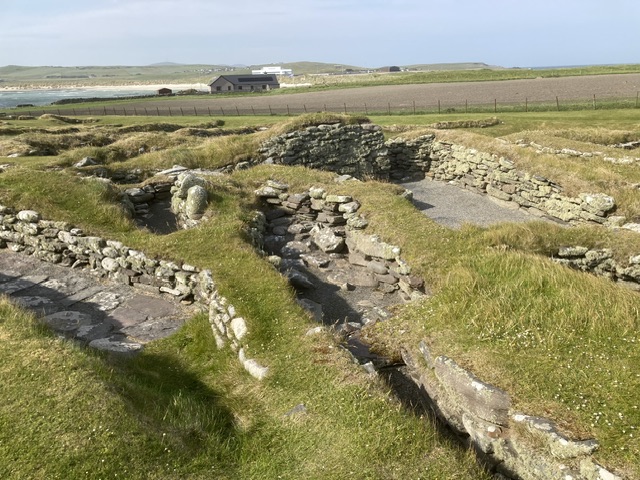
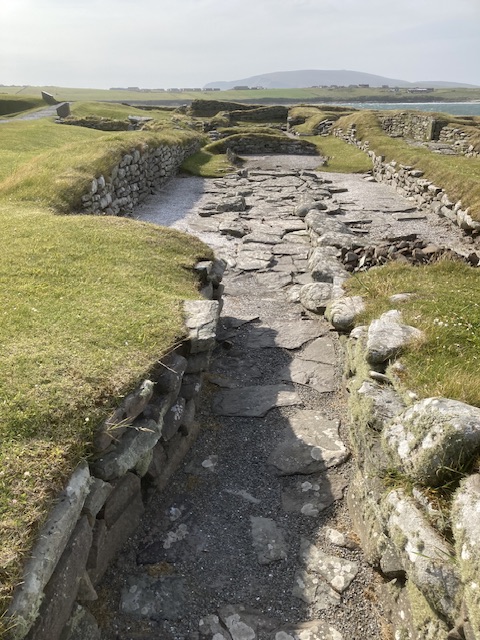
a Medieval farmstead
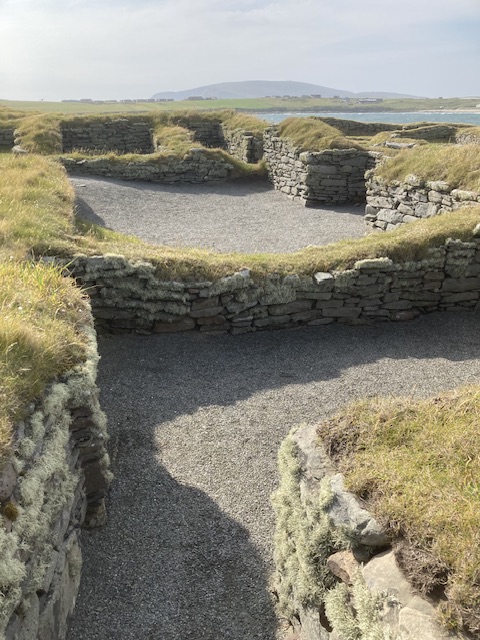

and a Laird’s fortification dating from the 1500s.

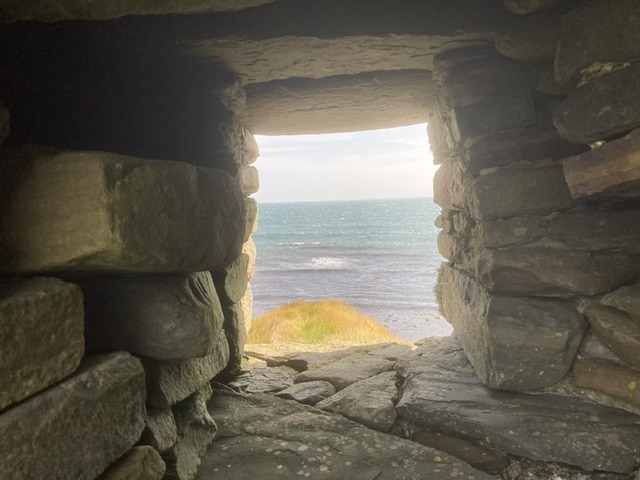
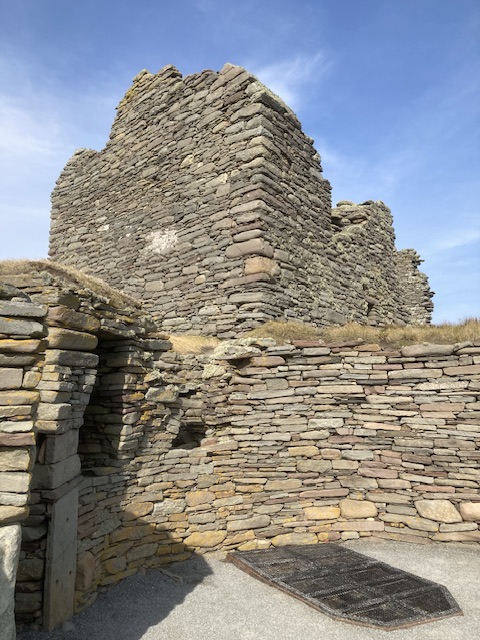

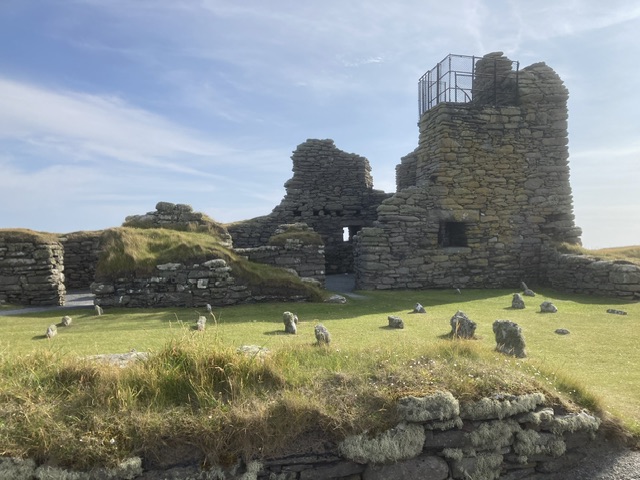
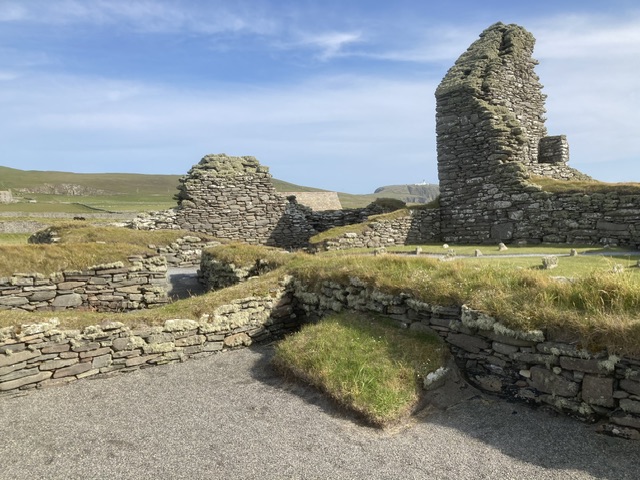
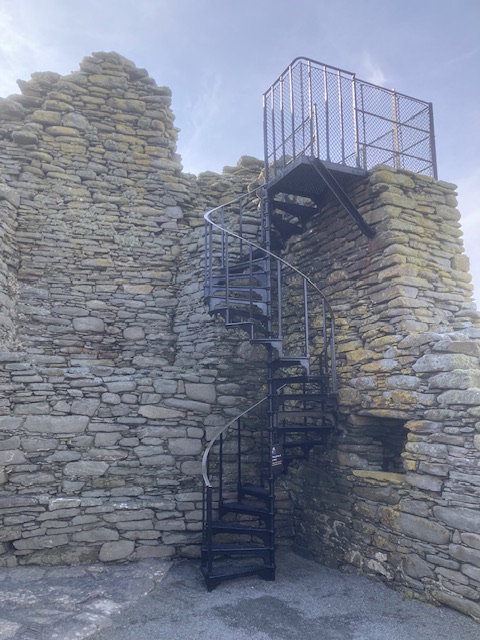
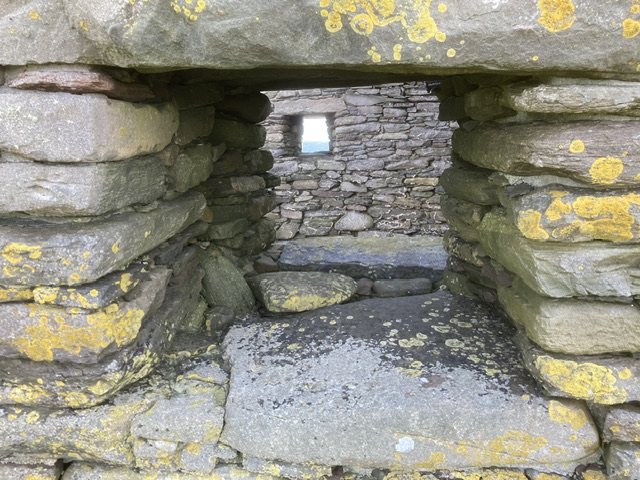
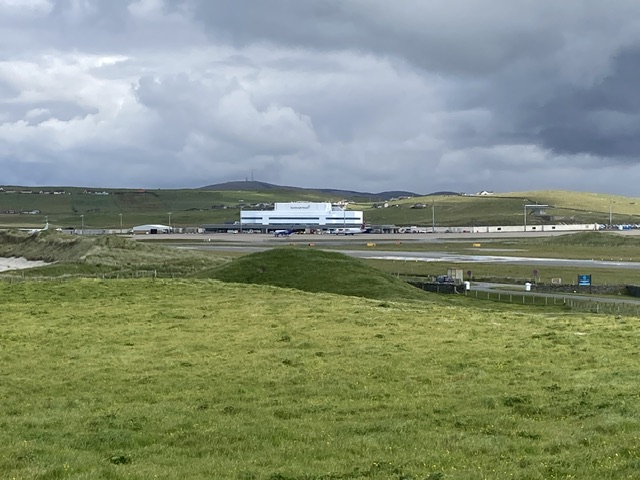
After the site closed, I set off to walk along the empty beach to see how much of the airport I could see from the grassy sandbanks. The early evening light was delightful.
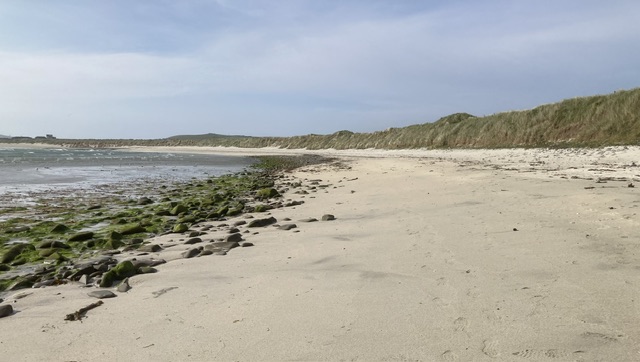

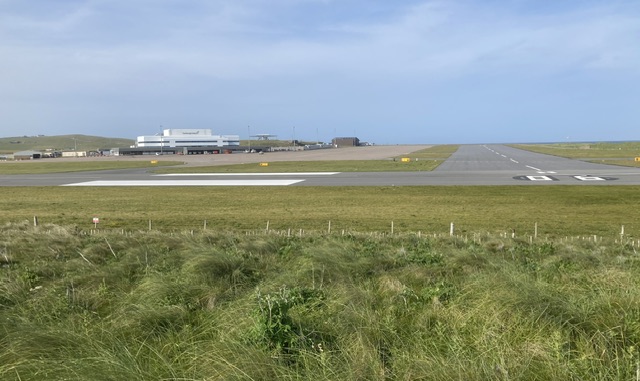
I couldn’t see much more than is visible from the road, and resolved to ask Mark tomorrow to stop the minibus to allow me to photo the road crossing the runway.
Friday 13 June 2025 – the last day on Shetland
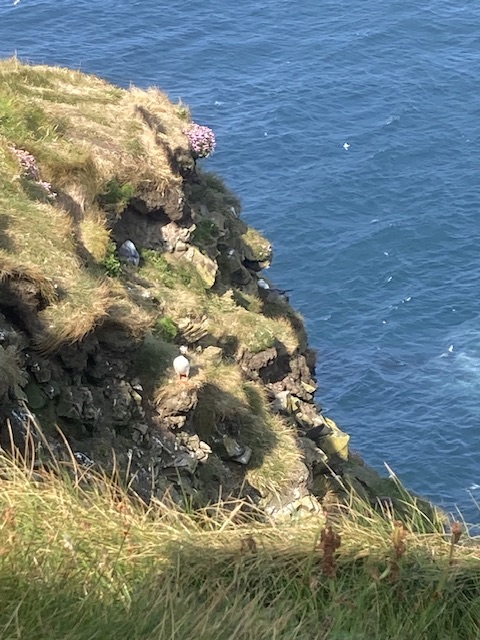
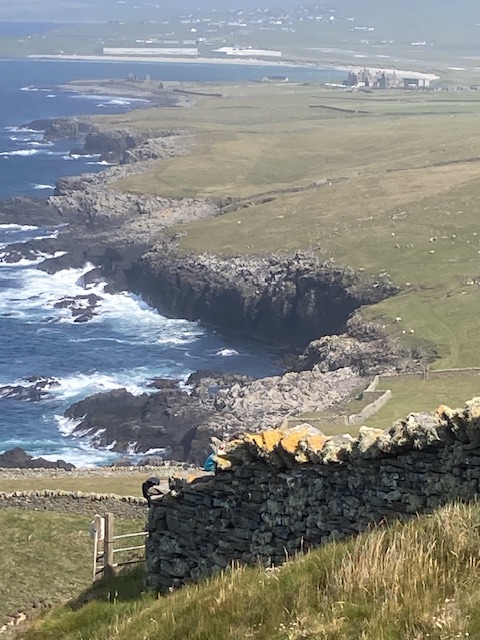
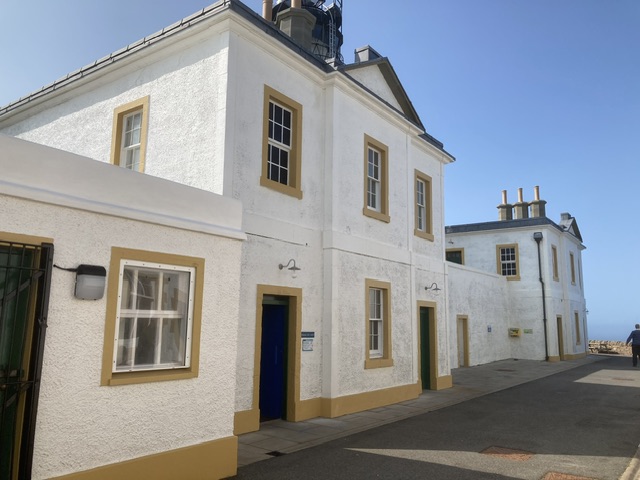
It was a gentle mopping up sort of day – Mark selecting places reasonably local to Lerwick and the ferry which departs for Aberdeen at 17.00. We drove up to Sumburgh Head again on a beautiful morning to admire the puffins once more and to patronise the shop
Yet another rare bird nearby had popped into Mark’s birding whatsapp. We set off in pursuit, stopping for some other elusive bird at just the place from which I could photo the road crossing the runway. And best of all, as I was inspecting the road barrier, a plane taxied up the runway, turned about, and took off. And of course, the barrier was down!


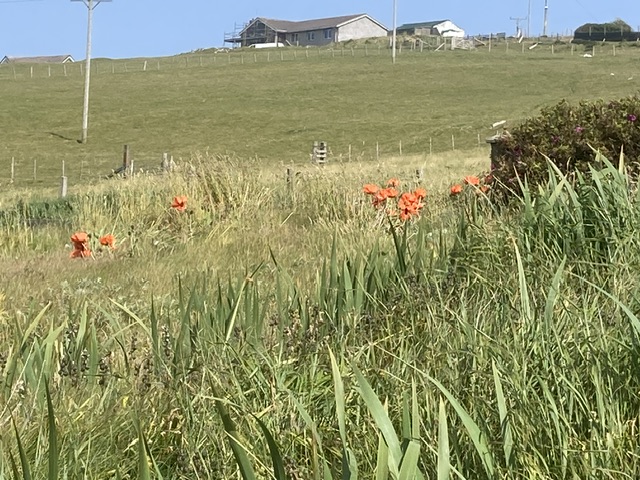
Very exciting! As was finding the red-backed shrike on one of the telephone wires in this field:
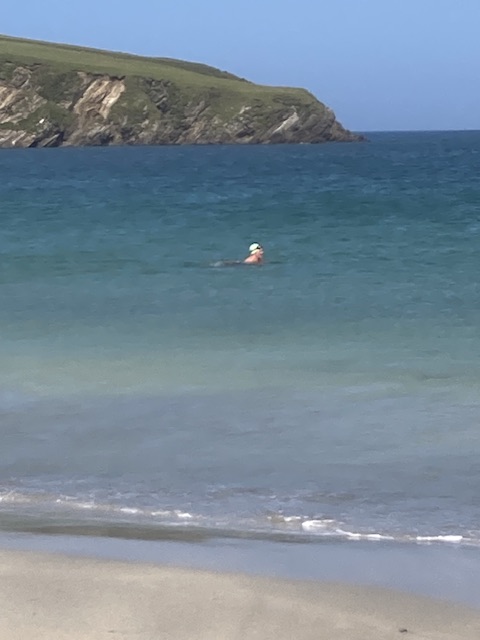
We moved on to one of the better known sites on Shetland : St Ninian’s Bay which was enchanting. Here we saw at least two intrepid swimmers (human beings) without wet suits, several birders and walkers, and glorious sands where the sea ebbs and flows on both sides of the isthmus.


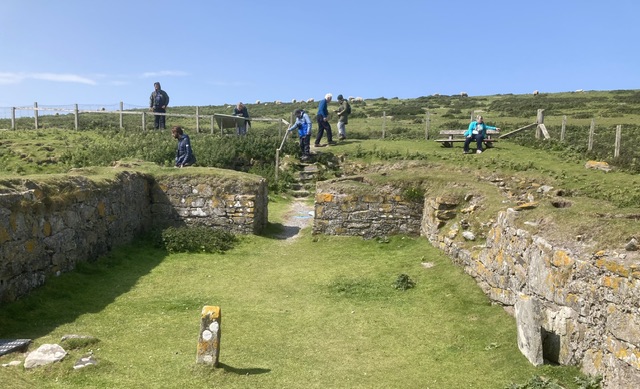
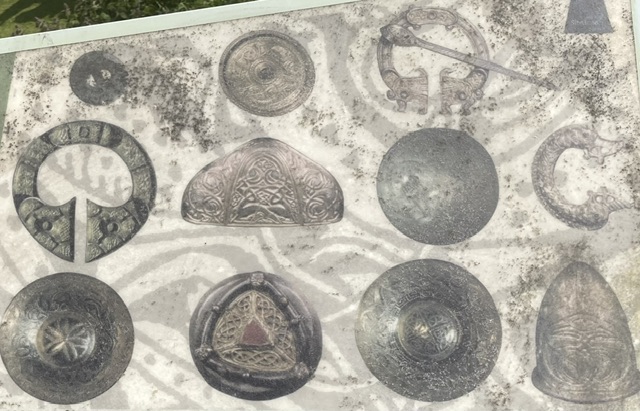
St Ninian’s Chapel itself is a modest structure, largely famous for the Pictish treasure found there during an excavation in 1958. Apparently a shetland school boy had found the remains of a wooden box containing 28 silver objects, many elaborately carved, and the rest is history..
We lunched at Hoswick where some of us particularly enjoyed smoked mackerel pate and the special ambience of the cafe, which served as an information as well as food supplier. Information was everywhere, and for the first time I found a useful (and free) map of the whole archipelago, as well as a very fine geological map of the British Isles – though not for sale.


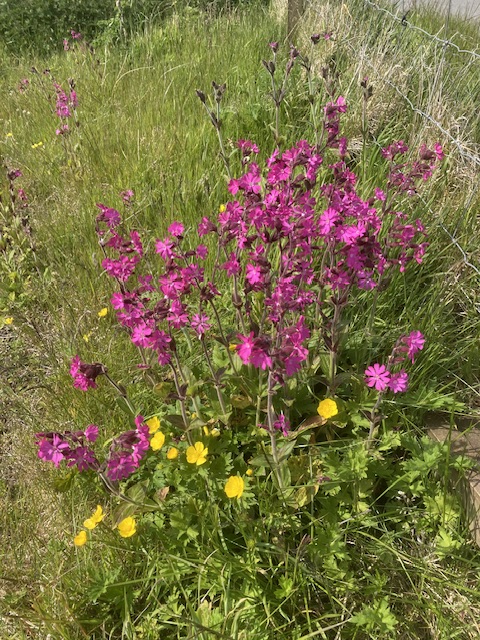
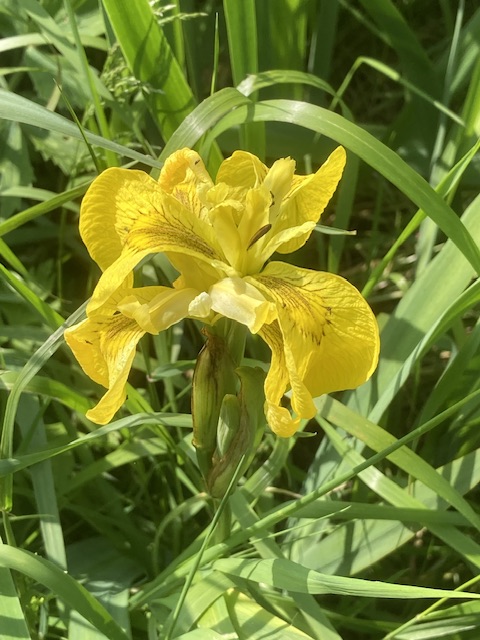
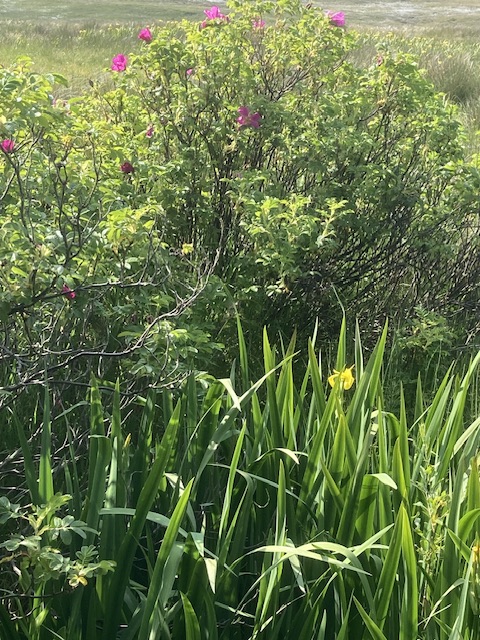
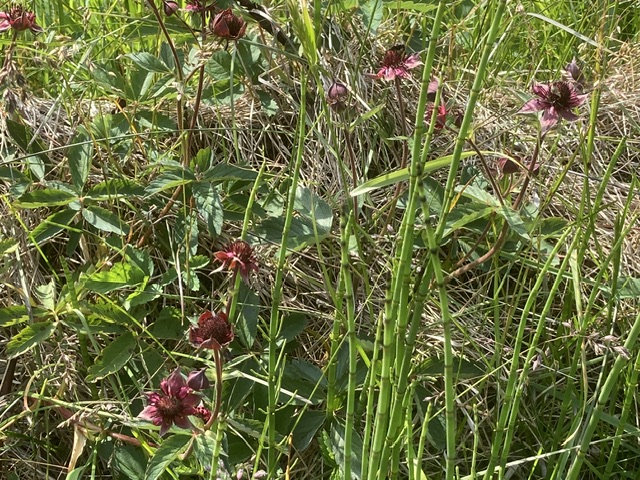
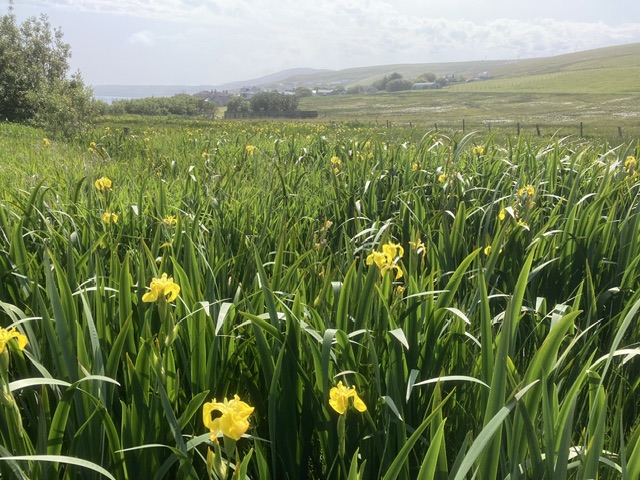
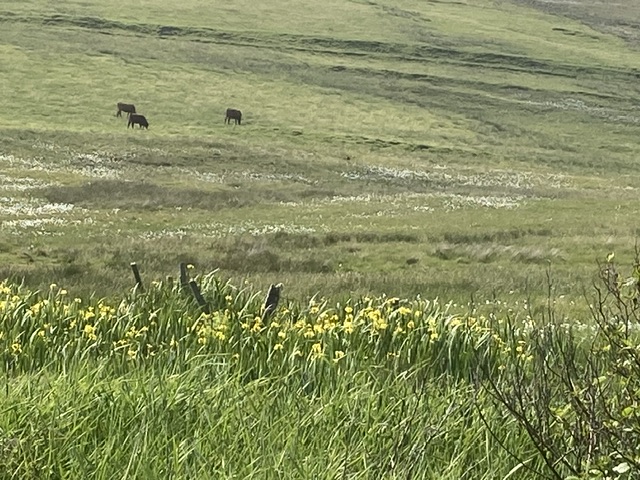
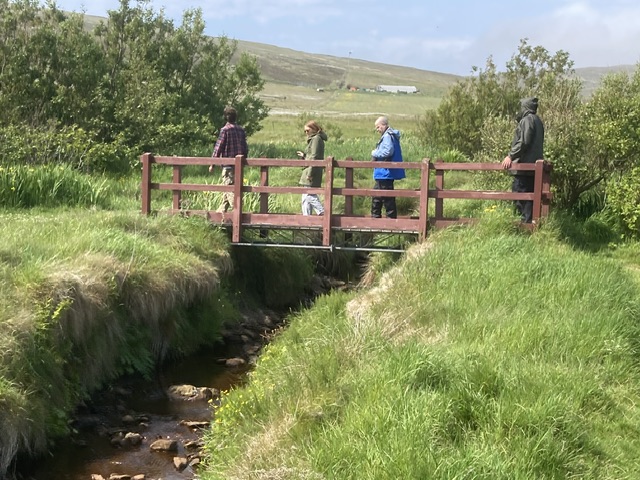
Our final, modest but delightful expedition was a walk along the burn in Hoswick to look at the flowers that this little oasis of cover has supported. In one sense it was unremarkable; species that one might expect to see in lots of places – but of which we had seen few in our time on Shetland. It was a warm, sunny afternoon; a fitting and civilised final celebration of the wildlife of Shetland, made special by Mark’s enthusiasm for plant life as well birds. Thank you Mark!






Mark delivered us to the ferry terminal in Lerwick at 16.00 with our luggage, and we made our way on board. Hugh had his eyes on a banquette in the lounge area, that he colonised as soon as the other users had dispersed later in the evening. I had spotted a young woman on the outward journey bagging a pitch in the pod lounge, on the floor, behind the seating.
It was dark, out of the way and – most importantly – flat. I staked it out with a blanket and pillow early on the journey, and retreated there once we had left Orkney. I had five & half hours’ sleep.
Saturday 14 June 2025
We docked at 07.00 and disembarked at wet and quiet Aberdeen. We made our way to the huge M & S complex in the shopping cnetre, where we eeked out breakfast until 10.00. Despite our flight being scheduled for the late afternoon, we took the bus to the airport, and colonised the only bench on which it was possible to lay down, and took it in turns to mind the luggage, while the other had lunch.
There begin a series of very mixed messages about a very variable departure time which tantalised for several hours, until suddenly we were boarding, and quickly airborne. (I think another flight was cancelled, and we got its pilot!! )
The journey from Gatwick was straightforward. We were home by 20.30, despite having to travel from Clapham with zillions of rugby fans high on success at Twickenham. Next time we’ll fly… to Sumburgh!
 countrymouse