
Friday 5 September
After we had tasted and talked with Guiseppe Gorelli at his winery close by Montalcino, we drove through the Friday late afternoon traffic to a car hire in the industrial estate in the south of Siena.
We arrived at 17.53, just in time to hand back the car to two efficient and motivated men, one of whom waited until our taxi arrived before heading home himself. (Their office closed at 18.00!) The taxi took us to Hotel NH Siena, on the via Federigo Tozzi, just opposite the bus terminal, where our room overlooked the Siena’s football stadium, being carefully tended by a conscientious groundsman in readiness for the new season’s first game.
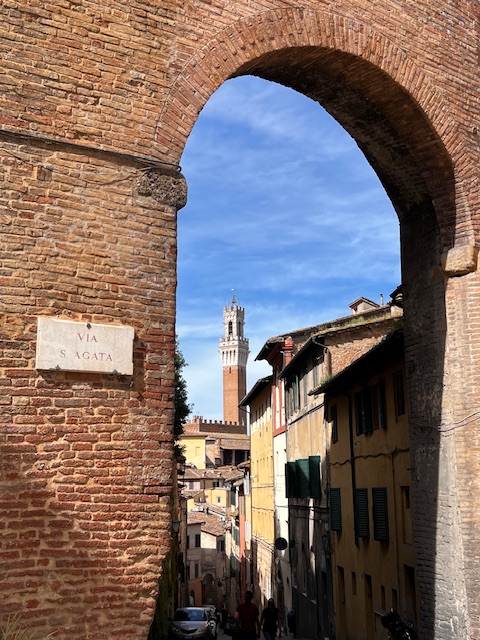
We headed away from the very busy roads leading to the Campo, and walked north on the pedestrianised via Camollia, full of eateries and local young people. We ate well at Osteria la Piana, and then walked down the via Francigena into the still heaving campo, to see the magnificent Palazzo Pubblico with the moon shining brightly above it in the very warm night.

Saturday 6 September
Of course English schools were back, but not many of the Italians, which meant that as well as older tourists like us, there were also lots of children and young people filling the streets.
I was very keen to see the fantastic frescoes in the Palazzo Pubblico, having been thwarted last Easter by a restoration closure, which had meant that Lucy, James, Ernest and Olive were deprived of that pleasure.
The galleries weren’t busy (though a marriage was taking place in the heart of the Palazzo and the photographer thought little of shooing people out of rooms they were parading through on their prolonged photoshoot)

We had a fantastic morning viewing the famous The Well-Governed City painted by Ambroglio Lorenzetti between 1337 and 1340 (as the latin beneath reports) in the Sala della Pace, where the Nine (the governing body) routinely met.
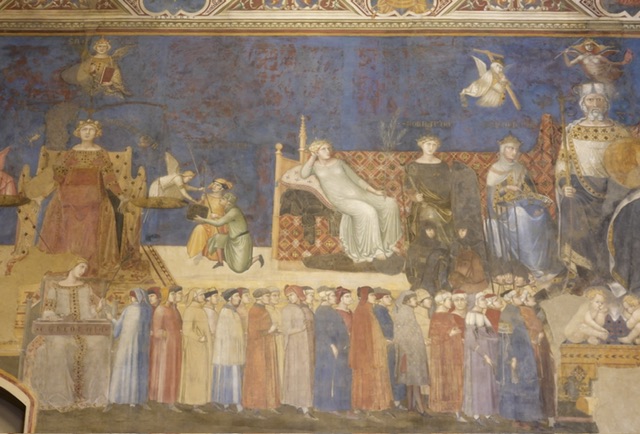

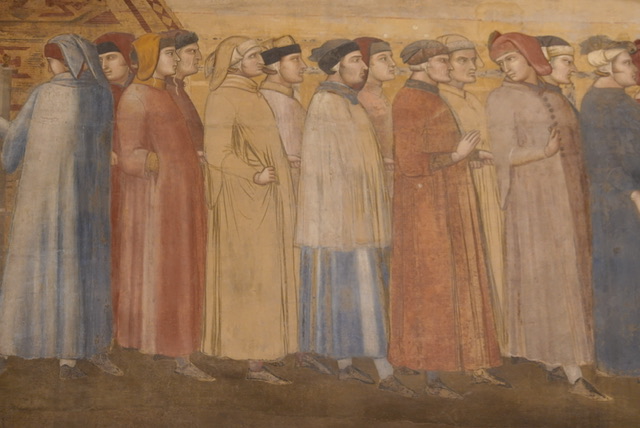
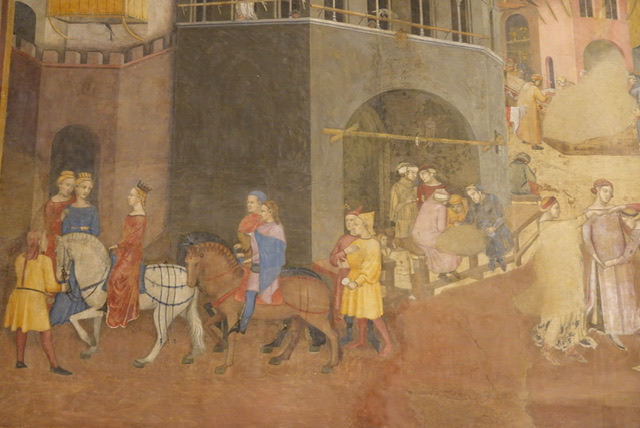
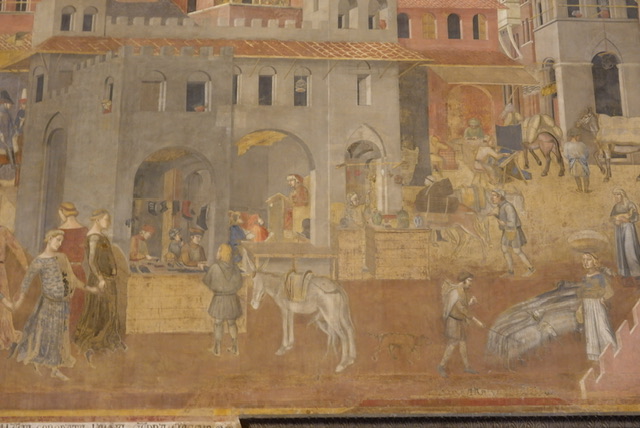
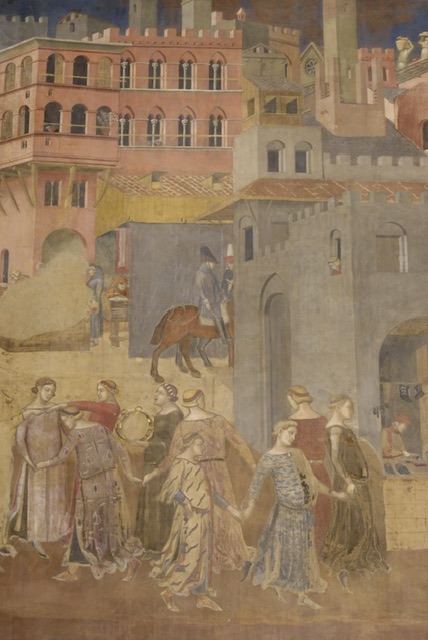
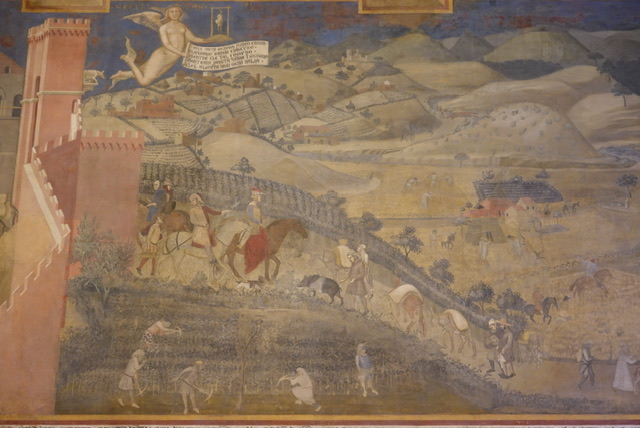

The scenes are breath-taking, and in extraordinarily good repair. The representation of the landscape leading up the orderly road to the gate of the Well-Governed City, painted on the longer wall at right angles to the painting of the court, gives the viewer access to the idealised richness of country life, and offers so many examples of medieval land use.
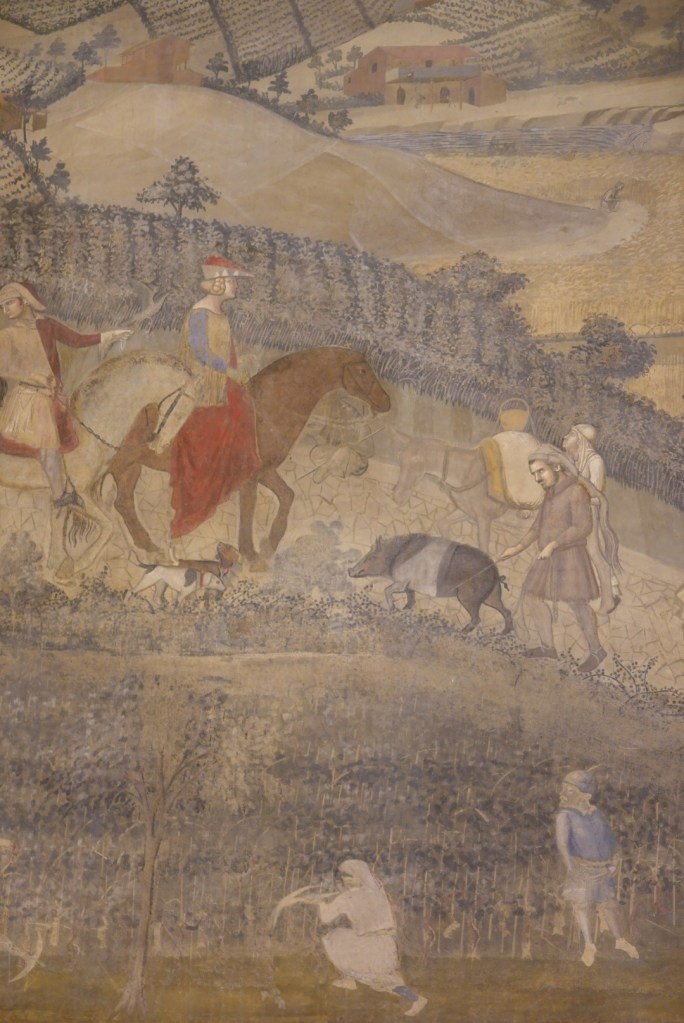
The Cinta Senese, the name by which the black and white pig is known, is beautifully rendered.
On an adjacent wall is what remains of The Ill-Governed City, also by Ambroglio Lorenzetti. It illustrates the consequences of poor government: violence and hardship, a barren and bleak landscape, presided over a tyrannical demonic figure
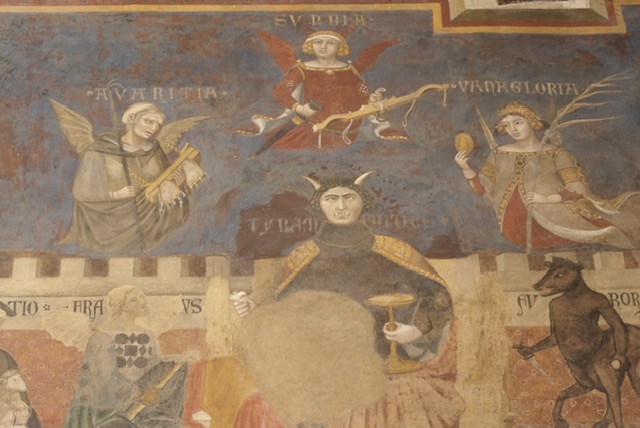

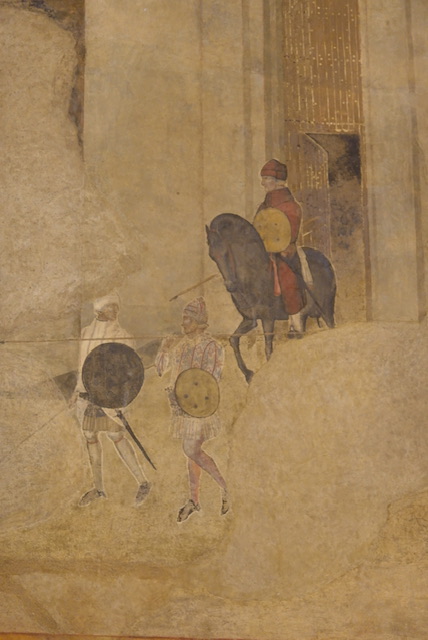
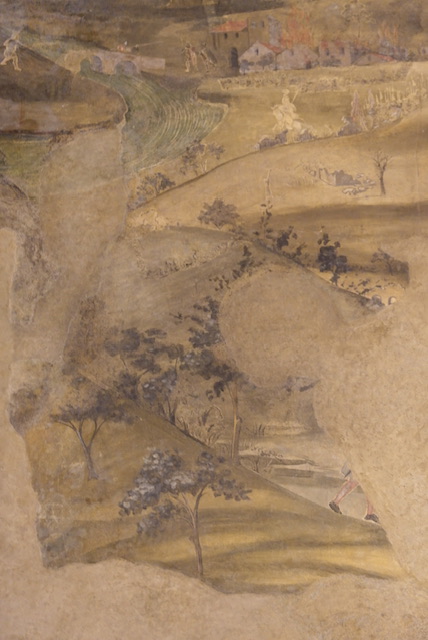
Every space in the Palazzo is filled with the outstanding art. Adjoining the Sala della Pace is the Great Council Hall, known as the Sala del Mappamondo, after the now lost World Map also painted by Ambroglio Lorenzetti.

Above the curved grooves which are all that remains of the Map, is one of the most famous and fetching of Siena’s paintings: Guidoriccio at the Siege of Montemassi. The attribution of this stunning piece is questioned; formerly given to Simone Martini, this is not yet resolved. Whoever painted it, it is magnificent!

Immediately below the Knight is a newly exposed fresco that pre-existed the Map (below) This somewhat obscured fresco is of a fortress town whose gates are wide open. Some speculate that this commemorates a peace agreement made by the Sienese with Santa Flora fortress in 1331 and its attribution is also questioned; the jury is out.

However, there is no doubt that Simone Martini painted the Maestà on the south-facing wall of this room, only a few years (1315, and reworked 1320) after that of Duccio was carried in procession on an ox-cart through Siena’s streets to the Cathedral’s high altar. This Maestà is a fresco – less expensive, faster to produce, far above viewers’ heads, and in now poor condition. (Info on Duccio’s great masterpiece follows shortly)
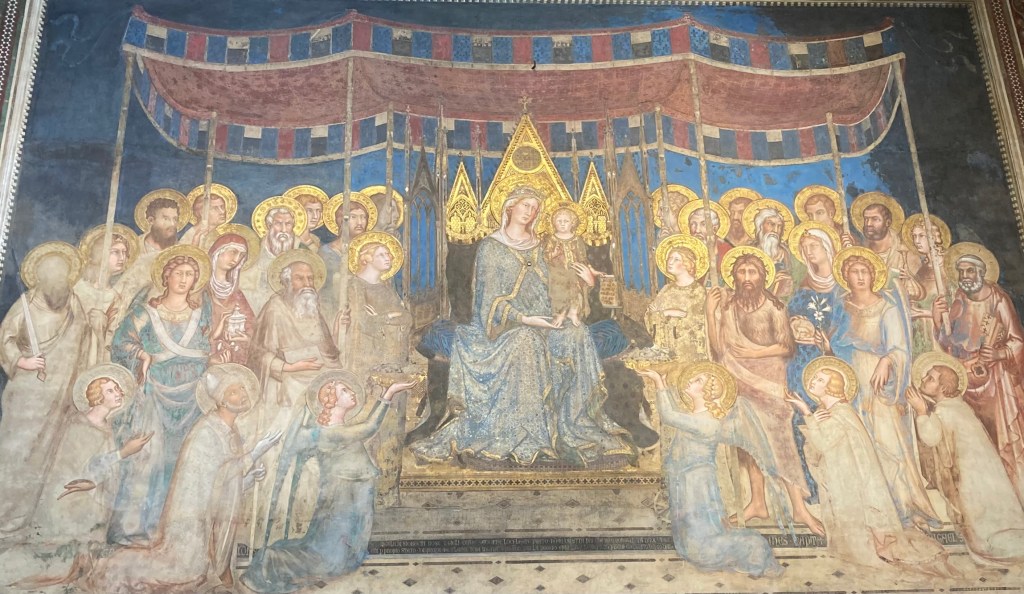
As Timothy Hayman writes in his Sienese Painting (Thames and Hudson 2022):
‘The protectress still hovers in the dark Cathedral; but now the Nine have invited her down into the Campo to preside over decisions of State.’
The Great Council Hall would have been in constant use as the vast Palazzo was the seat of government, visible for miles. The view from the top floor balcony of the surrounding Sienese territories takes your breath away – but was very difficult to photograph!
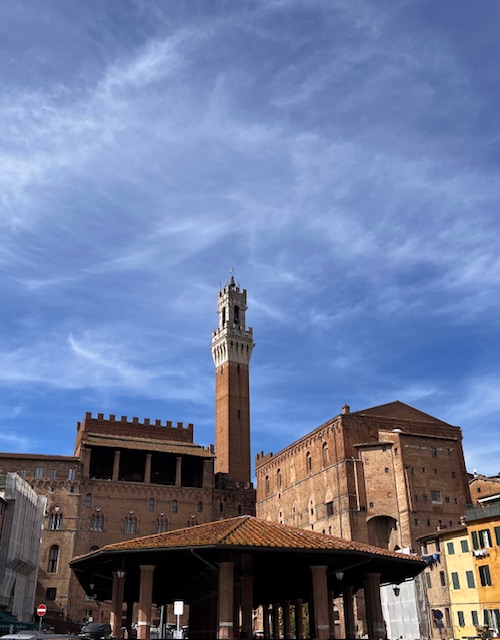
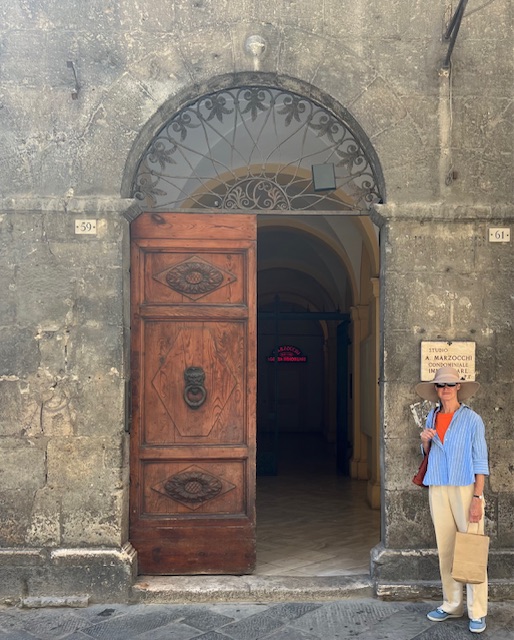
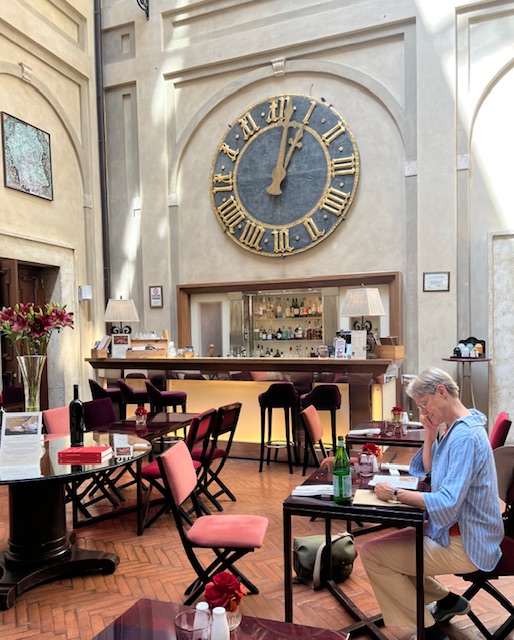
For lunch we retraced our steps to the via Banchi di Sopra to find the entrance to our apartment of last year, and to inspect the Grand Hotel Continental almost next door in which David’s Wine Scholar Guild’s tuscan tour will stay next April. It enjoys a great position so close to the Campo, and has a magnificent interior, which we were able to enjoy as we lunched in its bar!
Our next cultural treat was the Duomo – Cathedral. Despite frequent visits to Siena, our first and only sighting of its interior was with Jane Hunt MW on our Arblaster and Clarke wine tour of Tuscany in 2006. We were once again fortunate that its spectacular mosaic floors were uncovered, and we joined the crowds slowly filing around the maze of walkways.


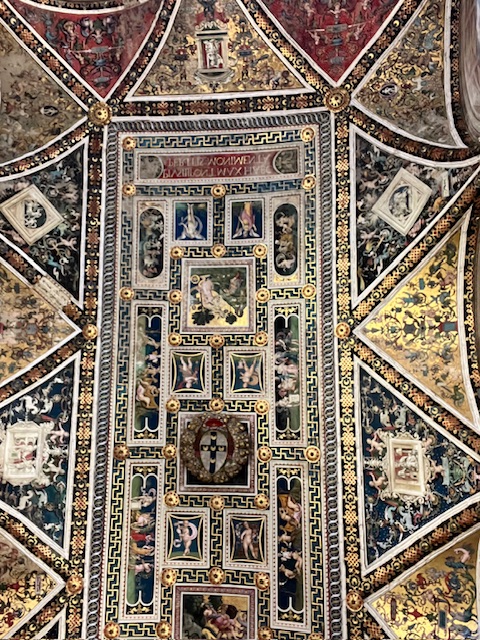

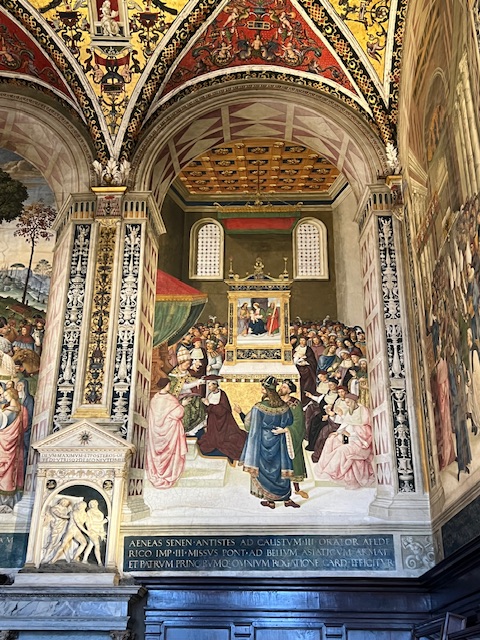
It is an extraordinary building. Its sheer size beggars belief; its decoration – floors, ceilings, walls, inside and out, is overwhelming. Built at the beginning of the 1300s, Siena was enjoying international attention – a hub for pilgrims, popes, emperors, bankers and myriad traders in silk, gold, spices, and of craftsmen, sculptors and artists, travelling from East to West, from Northern Europe to Rome, and back….
The Duomo enjoyed massive investment and ornamentation, and not only via ecclesiastical channels. Those who governed Siena invested in art – almost exclusively religious art – which adorned civic offices as well as churches, and portable pieces were used for private devotions.
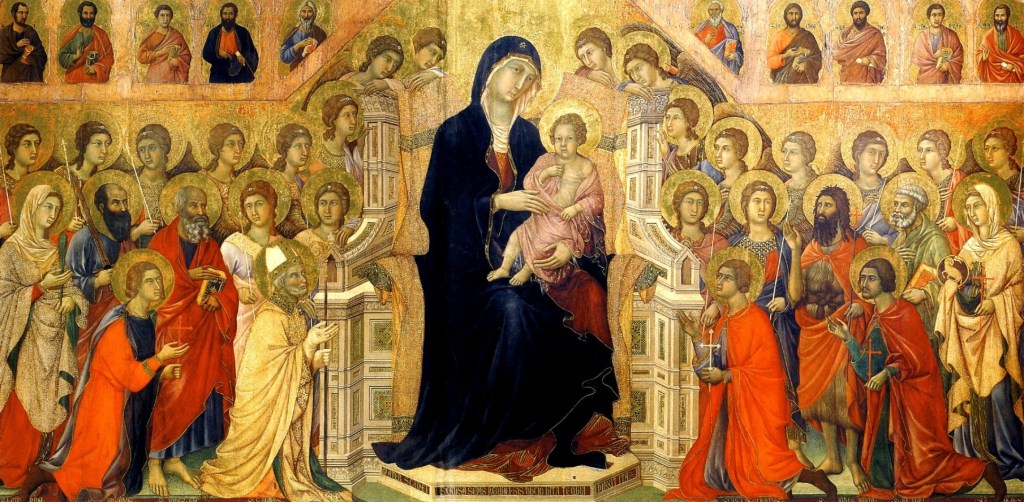
The staggeringly beautiful Maestà of Duccio di Buonisegna (1255 – 1321) was commissioned by Siena’s governors, not by the church, to beautify the high altar of the newly built magnificent Cathedral, and occupied this position, in full sight of the faithful Sienese, for several centuries.
And it was the hallowed gallery of the Museo Dell’Opera to which we went next. The ticket arrangements now mean one must buy a ‘complesso’ (ie pay for access to everything) to gain access to this. It does keep the numbers under control; the deeply respectful hush, which we experienced first on 13 August 2006, remains (I have that entrance ticket still – €6 each)
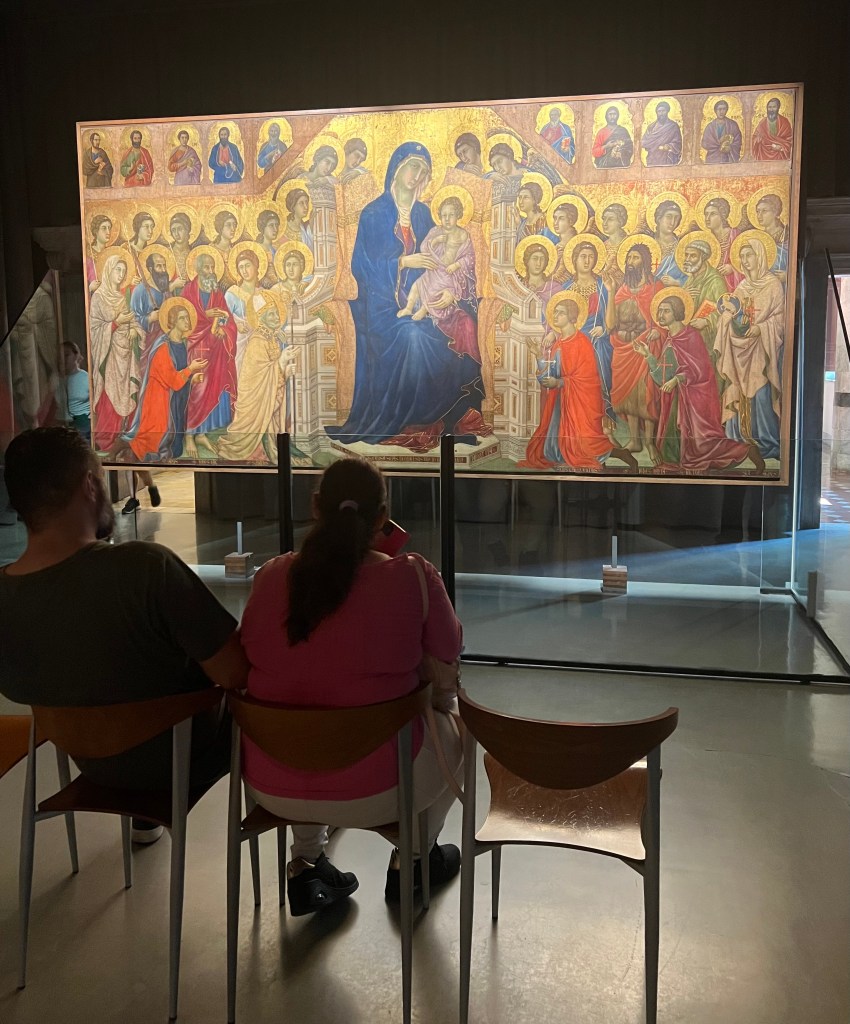
The National Gallery hosted a major exhibition Siena: The Rise of Painting 1300 -1350 in the spring of 2025 where many of the panels from the reverse side of Duccio Maestà were brought together, some for the first time since they were dispersed in the 17th century. (See a previous blog about this exhibition dated June 2025)

Duccio (and probably his assistants) used their consummate skills to tell the story of Jesus’ life, trial, death and resurrection. These would have provided the backdrop for the monks as they sang the Daily Offices in this space behind the high altar.
On display alongside the Maestà in Siena is another of Duccio’s earlier exquisite pieces, known as the Madonna of Crevole, painted in 1284.

We returned to the hotel for a rest. Our final meal was in an old favourite, Osteria Le Logge, once the business of Gianni Brunelli, whose widow Laura we have visited at their winery in Montalcino, and who we have occasionally run into at VinItaly. It was a hot night, and we ate outside, in the narrow via del Porrione, as the tourist tramp continued well into the night.
Sunday 7 September
Our train was mid morning, so we walked to the cafe which we visited with James and co last year, with an exceptional view of the great Duomo, sited on the highest ridge across the valley. We missed them!
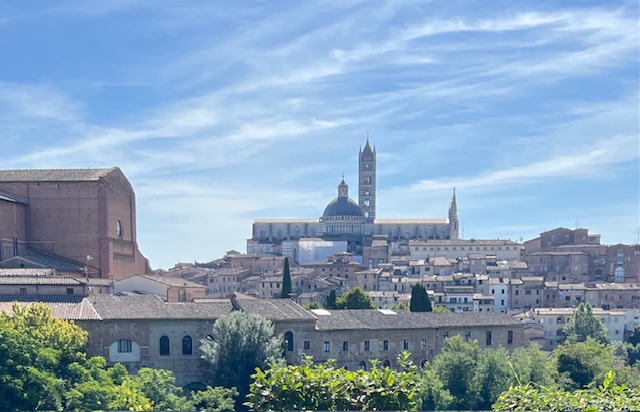

Returning to the hotel for the luggage and a taxi, we caught the Florence train, parting company at Empoli where I took the train to Pisa, just across the platform, and David travelled on, changing in Florence to a fast train to Milan, in order to be in place the next morning for a press trip transfer to the Nebbiolos of Valtellina. He spent the early evening in central Milan, seeing the sights.
We later realised that between us we had seen not one but three magnificent medieval cathedrals, in their respective cities on the same day…. Which gets the prize? They ALL get the prize…


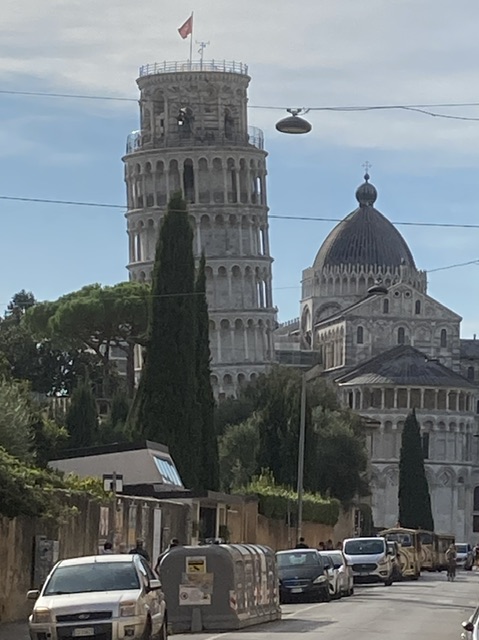
Meanwhile, in Pisa by early afternoon, I walked to the very convenient, rather functional hotel Hotel Moderno on via Corridoni 103, and after getting my bearings, set off to the Campo Miracoli to see once again the drunken tower, and the magnificent Duomo, Baptistry and Camposanto museum.


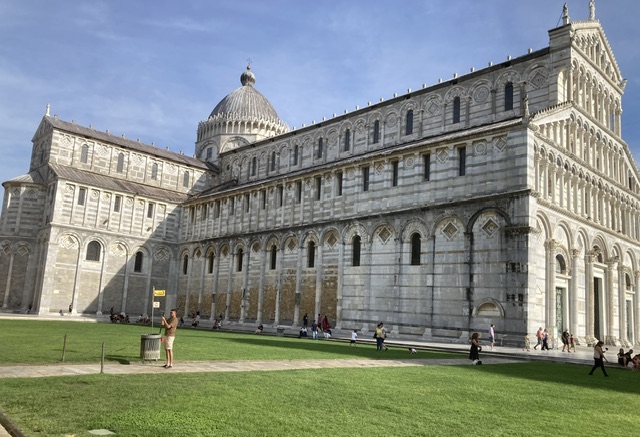

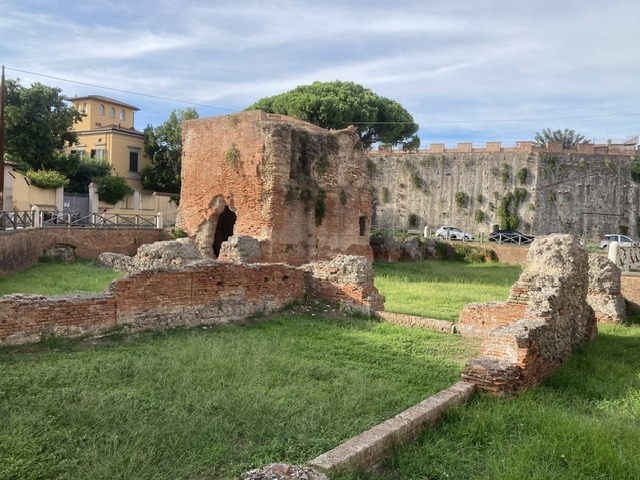
It was another warm day, and I enjoyed a large beer on a quiet street only two hundred metres from the milling crowds, with the wonky tower in full view, walking past the brick Roman gate out of the old city.

Monday 8 September
To my delight, the quickest way to the airport was on foot. I arrived in 15 minutes, following a handful of fellow travellers over a substantial footbridge, and ‘sempre dritto’, and via a car park, to Arrivals. I was home by 16.00. When the Gatwick – Andover train works, it’s fantastic.
David flew home from Milan on Wednesday.
 countrymouse